
Fang Lijun: The Bald Truth of Chinese Cynical Realism
The Existential Yawn: Fang Lijun’s Bald Figures and the Disenchantment of a Generation
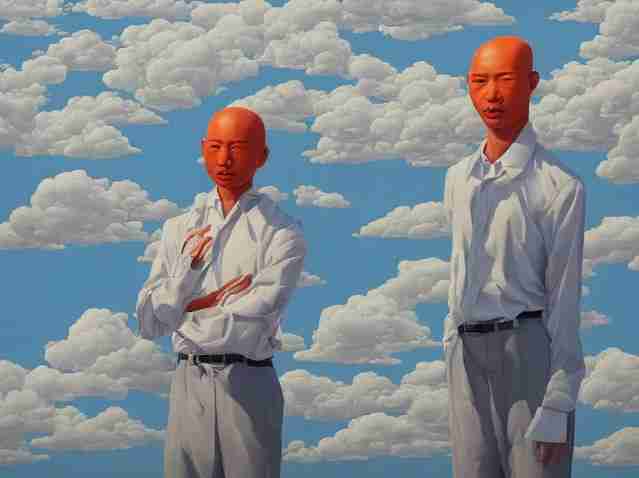
Fang Lijun did not simply paint bald men. He gave post-1989 China one of its most unsettling faces: tired, laughing, anonymous, and impossible to fully read.
Fang Lijun stands as one of the most emblematic figures of the Cynical Realism movement, a pivotal art movement that emerged in China during the early 1990s. His art is instantly recognizable, characterized by bald figures adrift in an existential void. These figures, often caught mid-yawn or mid-shout, convey a profound sense of ennui and disenchantment. They mirror a generation grappling with the harsh realities of their world. Fang’s work speaks to an era of transformation and uncertainty in China. It invites viewers to confront the pervasive apathy and disconnection that many felt during this tumultuous period.
Bald Figures in the Void
The most striking feature of Fang Lijun’s work is his bald figures, whose shaved heads and blank expressions create an almost alien sense of uniformity. These figures are often depicted as floating or falling through empty, endless skies, or drifting aimlessly in water. Their expressions, mid-yawn, slack-jawed, or emotionless, evoke boredom and disillusionment. The effect is a hard detachment from surroundings, as if life is happening somewhere else. These figures drift without a visible purpose. They become emblems of an existential crisis, shaped by a society that changed too quickly to offer stable meanings.
Cynical Realism and Social Commentary
Fang’s work is deeply rooted in Cynical Realism, which emerged as a response to political upheaval and the societal transformations of late 20th-century China. The movement carried a distinct disillusionment with traditional values and a skepticism toward the promises of political ideology and economic progress. The bald, yawning figures embody that disillusionment. They reflect the futility of a system that demands productivity and conformity while offering little sense of purpose.
Fang’s figures often appear isolated even when surrounded by others, highlighting the disconnection and loneliness that can come with social conformity. Detachment becomes a form of silent protest, a refusal to fully participate in a reality that feels increasingly alien and oppressive. The yawning and shouting figures are also a comment on the absurdity of existence, holding frustration and despair in a single bodily gesture.
The Yawn as Symbolism
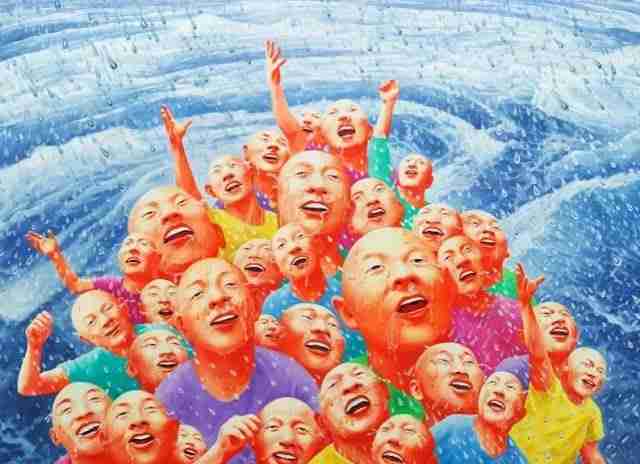
The repeated motif of the yawn in Fang Lijun’s work carries profound symbolic weight. The yawn, a simple and almost involuntary act, becomes a statement of resistance. It reads as exhaustion and disinterest. It symbolizes a refusal to perform excitement for a society that has lost its meaning. In this sense, the yawn is both personal ennui and a critique of a broader socio-political landscape that demands enthusiasm and conformity while leaving many people empty and disconnected.
By capturing his figures in this act, Fang challenges viewers to consider the emotional and psychological toll of living in a world where individuality is stifled and genuine emotion is often suppressed. The yawn, with its blend of indifference and dissatisfaction, becomes a symbol of the struggle for authenticity in an environment that rewards those who follow the script.
Bleak Landscapes and Mundane Realities
The settings of Fang Lijun’s works are often sparse, bleak, or surreal. An empty sky, an open ocean, or a vast featureless landscape are common. These empty environments emphasize isolation, placing the figures in a void that mirrors internal emptiness. The choice of such settings produces disorientation and reinforces themes of existential crisis and disconnection.
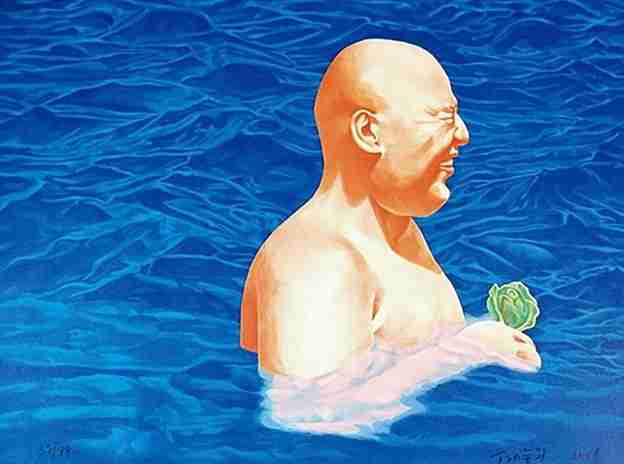
In these environments, Fang’s bald figures become symbols of a broader collective experience marked by uncertainty and a search for meaning amid chaos. Their blank expressions and indifferent body language invite viewers to confront their own disenchantment. The work quietly asks whether life can become a drift, and whether drift can become a habit.
The Disenchantment of a Generation
Fang Lijun’s work resonates with those who experienced dramatic social and political change in China during the late 20th century. Economic reforms, modernization, and the long aftermath of the Cultural Revolution created a landscape of confusion, opportunity, and disillusionment. Many found themselves caught between the ideals of the past and the uncertainties of the future. Fang’s art gives visual form to that disenchantment, translating frustration and anxiety into a consistent, unforgettable icon.
The yawning bald figures suggest collective resignation, a resignation shaped by the feeling that the system moved so rapidly and so fundamentally that it became impossible to match its demands. Fang’s work asks what it means to search for meaning inside a society that can seem adrift from its own promises.
Fang Lijun’s art, with its bald figures and existential yawns, is both reflection and critique. It captures the emotional landscape of a generation grappling with uncertainty, alienation, and a loss of meaning. By inviting viewers to confront the apathy and disconnection that many felt during this era, Fang’s work resonates beyond its cultural context. It speaks to a universal struggle for purpose and authenticity in a world that often rewards compliance and staged cheerfulness.


