
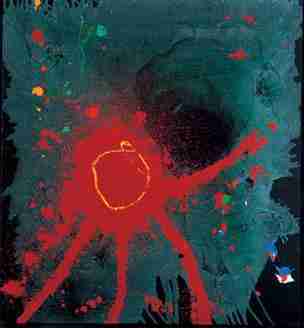
Lyrical Abstraction: When Gesture and Color Became Emotional Language
https://www.thearttrace.com/tag/georges-mathieuIn post-war Paris, painters including Wols, Georges Mathieu and Hans Hartung began treating the canvas as a field of immediate decisions.
Lines accelerated, colors collided and painted marks appeared to register thought before it hardened into explanation. This approach became known as abstraction lyrique, or Lyrical Abstraction.
It was more than an emotional alternative to geometric abstraction. It proposed a different idea of structure. Instead of determining the composition before painting began, the artist allowed form to emerge through movement, resistance, accident and revision. Painting became an event whose outcome could not be entirely predicted.
Lyrical Abstraction did not eliminate structure. It moved structure from the plan into the act of painting.
This distinction still matters. Gestural abstraction is often reduced to the romantic image of an artist releasing emotion onto the canvas. Its most important works do something more difficult: they turn physical action into a visual form of thinking.
What Is Lyrical Abstraction?
Lyrical Abstraction is an approach to non-figurative painting centered on gesture, fluid color, improvisation and the material presence of paint. It emerged in Europe after World War II and later acquired a related, but distinct, meaning in the United States.
The word “lyrical” does not necessarily mean delicate, harmonious or beautiful. A lyrical painting may be violent, fragmented or anxious. What makes it lyrical is the way its composition develops through rhythm and sensation rather than through a fixed geometric system.
A line may accelerate and suddenly stop. A stain can remain transparent in one area and gather into a dense mass elsewhere. Empty space becomes an active pause rather than a neutral background. Meaning arises from the relationships between these events.
This brings Lyrical Abstraction close to Abstract Expressionism and the New York School, but the terms are not interchangeable. They developed through different critical debates, exhibitions and historical circumstances.
Abstraction Lyrique in Post-War Paris
The European history of Lyrical Abstraction belongs to the cultural disorientation that followed World War II. After occupation, genocide and destruction, the stability promised by rational systems no longer appeared politically or psychologically innocent. For some artists, geometric order seemed unable to register the instability of the period.
During the late 1940s, Paris became the center of several overlapping tendencies described as abstraction lyrique, Tachisme and Art Informel. These labels were never perfectly interchangeable. Tachisme emphasized the stain or tache; Art Informel described a broader rejection of conventional form; Lyrical Abstraction stressed the freedom and expressive rhythm of the painted gesture.
Wols compressed anxiety into tangled lines, stains and damaged-looking surfaces. In its account of his 1947 painting Aile de papillon, the Centre Pompidou describes a work whose meaning is concentrated in the tormented texture of the paint. The image seems to emerge and disintegrate at the same time.
Georges Mathieu pushed the gesture toward speed, calligraphy and public spectacle. Hans Hartung produced scratches, dark clusters and sweeping lines that appear spontaneous but were frequently grounded in prolonged technical research. Together, these artists challenged the idea that abstraction had to be constructed from stable, measurable forms.
Gesture Is Not Automatically Truthful
The mythology surrounding gestural painting often imagines an artist acting without preparation. According to this story, the mark is authentic because it is immediate: the body moves, emotion is released and the canvas preserves the evidence.
But immediacy can also be constructed. Hartung sometimes studied, transferred or enlarged gestures, and his later experiments included unconventional tools and sprayed paint. The Centre Pompidou’s record for T 1966-R4 connects his working process to the enlargement of the sign and the use of sprayed material.
This makes his work more interesting, not less authentic. A gesture does not become meaningful simply because it was executed quickly. Its importance depends on the consequences it creates inside the painting: how it changes the surrounding color, redirects the composition or makes the next decision necessary.
Freedom, in other words, is not the absence of discipline. It is the ability to respond to a situation that is still changing.
Paris and New York: Two Related but Different Histories
European abstraction lyrique and American Lyrical Abstraction are frequently presented as a single transatlantic movement. That account is too simple. European artists were developing informal and gestural abstraction in the late 1940s, while the English-language term gained a more specific American meaning around the end of the 1960s and beginning of the 1970s.
In the United States, Lyrical Abstraction identified a renewed interest in open composition, stained surfaces and sensuous color after the rise of hard-edge abstraction and Minimalism. It inherited aspects of Abstract Expressionism but often rejected its monumental mythology of the isolated, heroic painter.
Joan Mitchell provides an important transatlantic connection, although she is more precisely associated with the second generation of Abstract Expressionism. Her paintings build unstable fields from repeated strokes, interruptions and chromatic echoes. Sam Francis allowed pools of color to expand around areas of exposed canvas. Paul Jenkins guided liquid pigment across the surface, making gravity and viscosity part of the composition.
These artists did not merely illustrate private emotion. They translated sensation into spatial relationships: density against emptiness, acceleration against pause and transparency against saturation.
Why Lyrical Abstraction Feels Like Weather
Lyrical Abstraction is often explained through music. Its marks are described as rhythms, pauses, crescendos or improvisations. The comparison is useful, but I find weather more precise.
Music unfolds through an organized duration. Weather surrounds us, changes without permission and alters the appearance of everything it touches. A lyrical abstract painting can operate in the same way. Color is not simply placed inside a form. It spreads, evaporates, darkens or accumulates until the entire surface becomes a condition that the viewer enters.
John Hoyland’s later paintings demonstrate how long this possibility remained active. He was not one of the founders of post-war Lyrical Abstraction, and his work should not be used to illustrate its origin. It reveals the movement’s extended legacy. His saturated forms place color under pressure, somewhere between autonomous shape and unstable atmosphere.

In paintings like this, color does not represent weather. It behaves like weather. It controls distance, pressure and emotional temperature before the viewer has identified any stable subject.
From Gesture to Color Field Painting
The relationship between Lyrical Abstraction and Color Field painting is close but not seamless. Lyrical painting generally retains a visible sense of bodily movement and improvisation. Color Field painting often reduces the evidence of the hand and allows larger areas of color to dominate the experience.
In the work of Mark Rothko, color produces psychological intensity without depending on dramatic gesture. Barnett Newman used apparently simplified fields to address scale, presence and the sublime. Helen Frankenthaler’s soak-stain technique allowed diluted paint to penetrate unprimed canvas, making color and support materially inseparable.
What connects these approaches is not a single appearance. It is their refusal to treat color as decoration. Color becomes the subject, the environment and the force that organizes the viewer’s experience.
Jules Olitski and the Material Life of Color
Jules Olitski carried this investigation into some of the most materially adventurous paintings associated with American Color Field painting. Born in 1922, he emigrated from Soviet Russia to the United States as a child and became known during the 1960s for applying paint with an industrial spray gun.
The spray allowed Olitski to distribute color without describing conventional shapes or emphasizing the brushstroke. Pigment could appear suspended across the canvas like mist, light or atmospheric pressure. The surface seemed almost immaterial, even though the physical method used to produce it was highly controlled.
During the 1970s, however, Olitski’s painting changed. He began using cloths, scrapers and rollers, developing thicker and more structured surfaces. The gesture returned, but not as a revival of Abstract Expressionist performance. It became a way of testing the weight, resistance and texture of color itself.
This development complicates any rigid separation between Lyrical Abstraction and Color Field painting. Olitski could suppress the visible hand in one period and reintroduce physical movement in another. What remained constant was his insistence that color was not something applied to the surface. Color created the surface.
Recommended Book: Olitski’s Paintings, 1978–1983
For a closer examination of this crucial phase, Olitski. Paintings 1978–1983: Catalogue Raisonné of 73 Works — Figurative and Lyrical Abstraction documents 73 paintings produced between 1978 and 1983.
The volume is particularly relevant because it covers the period in which Olitski’s surfaces became increasingly physical and structured. It helps move the discussion beyond the celebrated spray paintings of the 1960s, revealing an artist who continued to reconsider the relationship between gesture, material and chromatic atmosphere.
As an Amazon Associate, The Art Trace may earn from qualifying purchases.
When Freedom Becomes a Recognizable Style
Every visual language created as an act of liberation eventually risks becoming a formula. Drips, stains and impulsive-looking brushstrokes can become as predictable as a geometric grid. Once spontaneity becomes an expected aesthetic effect, the gesture may stop carrying urgency and begin functioning as a signature.
This is the central contradiction of Lyrical Abstraction. It claims freedom, but freedom can also become a recognizable style. A painting is not convincing because its surface looks energetic. The real question is whether its marks create consequences within the work.
Does one gesture alter the meaning of another? Does color transform the space, or merely occupy it? Does the painting preserve uncertainty, or has uncertainty been reproduced as a decorative effect?
These questions separate lyrical abstraction as a historical vocabulary from painting that still thinks through gesture.
Why Lyrical Abstraction Still Matters
Lyrical Abstraction remains relevant because it preserves uncertainty inside the finished artwork. Its strongest paintings are not diagrams of something the artist already knew. They contain traces of a process in which sensation, material and judgment continually changed one another.
This does not remove the work from history. The rejection of rigid order in post-war Europe carried the pressure of a devastated political landscape. The American return to fluid color after hard-edge abstraction and Minimalism responded to a different artistic environment. The two histories intersect, but they should not be confused.
If geometric abstraction often resembles architecture, Lyrical Abstraction behaves more like weather. It surrounds the viewer before it can be decoded. Its gestures may be fragile, aggressive or hesitant, but they insist that painting can communicate before it becomes an explanation.
Its enduring legacy is not the belief that every gesture is truthful. It is the more demanding possibility that color and movement can make thought visible while it is still changing.


