Tachism: The Lyrical Dance of Postwar French Art
Tachism: Postwar Paris and the Lyrical Politics of the Brushstroke In the wake of World War II, the art world
Read More
Georges Mathieu was a French painter, theorist, and public figure who played a central role in the development of post-war European abstraction. He became one of the leading representatives of Lyrical Abstraction, promoting a spontaneous form of painting based on speed, gesture, improvisation, and the direct expression of creative energy.
Born in Boulogne-sur-Mer in 1921, Mathieu initially studied literature and philosophy before turning to painting. During the late 1940s, he rejected geometric abstraction and the idea that an artwork should be carefully planned before its execution. Instead, he argued for a freer visual language in which marks emerged through immediate physical action. His paintings often feature explosive lines, calligraphic signs, concentrated areas of colour, and large expanses of comparatively empty space.
Mathieu’s work developed alongside European movements such as Art Informel and Tachisme, while also sharing important affinities with the gestural painting of the New York School. His emphasis on movement and improvisation can be compared with the practices of Jackson Pollock and Willem de Kooning, although Mathieu developed his approach independently and within a specifically European cultural context.
One of the most distinctive aspects of Mathieu’s career was his decision to paint before an audience. In highly theatrical public performances, he produced monumental works at remarkable speed, sometimes completing them within minutes. These events transformed painting into a visible act and anticipated later developments in performance art. The artist’s body, gestures, and decisions became inseparable from the completed image.
Mathieu frequently gave his paintings titles inspired by battles, dynasties, rulers, and episodes from European history. These references did not turn the works into conventional historical illustrations. Instead, they created an emotional and symbolic framework for compositions governed by tension, acceleration, and dramatic contrast. His calligraphic forms suggest an invented language suspended between writing and image, but they resist any fixed interpretation.
Beyond painting, Mathieu worked in graphic design, architecture, furniture, posters, ceramics, tapestries, medals, and public commissions. He believed that art should participate in everyday life and sought to bring his visual language beyond museums and galleries. Today, Georges Mathieu is recognised as an essential figure in the history of post-war abstraction and as a crucial link between Lyrical Abstraction, gestural painting, and the emergence of art as a public action.
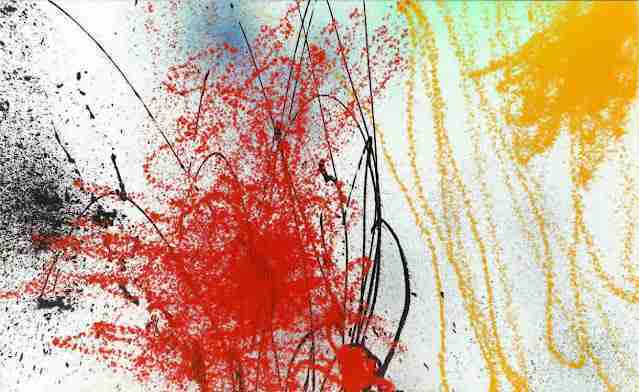 Hans Hartung - Untitle
Tachism: Postwar Paris and the Lyrical Politics of the Brushstroke In the wake of World War II, the art world
Read More
https://www.thearttrace.com/tag/georges-mathieuIn post-war Paris, painters including Wols, Georges Mathieu and Hans Hartung began treating the canvas as a field of immediate
Read More