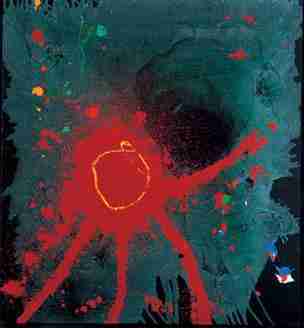
Joan Mitchell

Joan Mitchell was a major American painter whose emotionally charged canvases transformed landscape, memory, and personal experience into powerful abstract compositions. Closely associated with the second generation of the New York School, Mitchell developed a distinctive visual language based on energetic brushwork, complex rhythms, and intense relationships between colour and space.

Born in Chicago in 1925, Mitchell emerged within the artistic environment of post-war New York, where the radical approaches of painters such as Jackson Pollock, Willem de Kooning, and Hans Hofmann had expanded the expressive possibilities of painting. Although she was often connected to Abstract Expressionism, Mitchell resisted restrictive labels and constructed an independent practice shaped by observation, recollection, poetry, music, and the natural world.

Her paintings do not reproduce specific landscapes. Instead, they translate sensations retained from places into layered networks of marks, colours, and intervals. Trees, gardens, water, sunlight, and changing seasons frequently provided the emotional foundations of her work. Mitchell described her paintings as being concerned with remembered feelings rather than direct representations, allowing perception and memory to become part of the painting’s structure.

After moving permanently to France, Mitchell eventually settled in Vétheuil, near Claude Monet’s former home. The surrounding landscape became an enduring source of inspiration, but her work remained connected to the gestural freedom of American painting and the expressive openness of Lyrical Abstraction. Her expansive canvases combine rapid, forceful strokes with carefully controlled passages of white space, producing compositions that appear spontaneous while revealing sustained formal attention.

Mitchell’s approach to colour also established meaningful connections with artists such as Helen Frankenthaler and with the broader development of Color Field Painting. Unlike painters who treated colour as a unified field, however, Mitchell used it as a physical and emotional force, building tension through clashes, repetitions, pauses, and abrupt changes in intensity.

Today, Joan Mitchell is recognised as one of the most significant painters of the twentieth century. Her work challenges the historically male-centred account of post-war abstraction and demonstrates how gesture can function as a disciplined form of thought. Through colour and movement, she created paintings in which landscape is not simply seen but remembered, reconstructed, and emotionally experienced.