
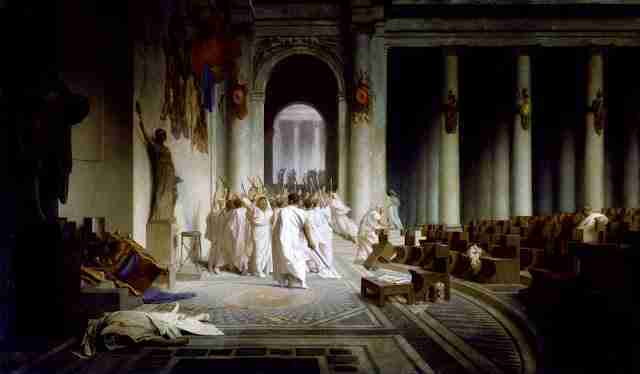
Jean-Léon Gérôme – The Death of Caesar: The Master of Classical Realism
Jean-Léon Gérôme – The Death of Caesar: The Master of Classical Realism
Jean-Léon Gérôme is one of the defining figures of 19th-century Classical Realism. His paintings are built on extreme technical control, but they never feel like mere exercises in skill. They are stages: historical tableaux, mythological scenes, and Orientalist spectacles. These are rendered with such persuasive clarity that the boundary between documentation and invention becomes unstable.
This is Gérôme’s special tension: the image looks “true.” Yet it is also carefully engineered to produce drama, desire, and narrative impact. In his work, realism is not neutral; it is a tool that turns history into presence and myth into something almost touchable.
Bridging myth, history, and spectacle in the 19th century
Gérôme’s world is built from precision: anatomy, architecture, costume, light, surface. Yet what he ultimately paints is not the past as a museum artifact, but the past as an event. His scenes feel cinematic because they are composed like encounters, with the viewer positioned at the edge of action, witness to a turning point.
Even when he depicts myths, he refuses mist or vagueness. He wants the miraculous to appear measurable, credible, and almost physical. That desire for credibility is what makes his work so captivating and, at times, unsettling. The viewer is seduced by the image’s authority.
The making of a master
Born in 1824 in Vesoul, France, Gérôme trained in Paris within the academic system that defined 19th-century artistic legitimacy. Under Paul Delaroche and later at the École des Beaux-Arts, he absorbed the values of disciplined drawing, anatomical accuracy, and controlled composition. He aimed for a finish that erases the trace of labor.
Early success at the Paris Salon consolidated his reputation. While the coming decades would be shaped by ruptures (Impressionism, then modernism), Gérôme remained committed to a classical ideal. He saw painting as a high craft capable of delivering narrative, beauty, and authority in the same image.
Historical tableaux as reconstruction
One of the most striking aspects of Gérôme’s work is his approach to history as reconstruction. His paintings are often described as archaeological. This is not because they are purely accurate, but because they are built to feel incontrovertible. Objects, textures, and environments are staged to convince.
In works like Pollice Verso, Gérôme turns ancient Rome into a machine of spectatorship. The crowd’s gesture, the defeated body, the glint of armor, the choreography of cruelty: everything is composed to make you feel the social mechanism of violence as much as the violence itself.

Orientalism, travel, and the politics of looking
Gérôme’s travels in the Middle East fed a large body of Orientalist paintings. Visually, these works can be hypnotic: light, pattern, skin, fabric, architecture, and polished surfaces handled with astonishing control. They are also inseparable from the 19th-century European imagination of the “exotic.” This gaze often turns living cultures into theatrical décor.
That double reality is important to acknowledge. Gérôme’s realism does not automatically equal truth; it can also authenticate fantasy. The paintings reveal as much about Western desire and power as they do about the scenes they claim to describe.
Mythology and allegory made tangible
When Gérôme turns to myth, he treats it like a real event occurring in real space. Pygmalion and Galatea is exemplary: the transformation is miraculous, yet the scene is painted with such material conviction that the miracle feels immediate. Skin appears warm, stone appears to soften, and the viewer is held in the precise moment when art becomes life.

This is where Gérôme’s technical genius becomes philosophical. He is not only showing a story; he is arguing that painting can generate belief. The boundary between the represented and the real is not merely depicted. Rather, it is tested.
The spectacle of the everyday
Gérôme is famous for arenas, emperors, and mythic scenes, but his quieter works reveal a different intensity: the ability to elevate intimacy without inflating it. In his bathing scenes and private moments, he applies the same discipline of observation to gestures that are small, human, and close-range.
These works suggest a core idea behind his practice: beauty is not limited to epic history. It can be engineered from attention itself, from the way light hits skin, from the silence inside a room, or from a posture that becomes narrative.
Legacy: why Gérôme still matters
Gérôme’s legacy is not only technical. It is about how images persuade. He demonstrates that realism can be a powerful narrative technology: it can pull viewers into a constructed past and make it feel authoritative, immediate, and emotionally charged.
That is why Gérôme remains relevant today. His work forces a question that still matters in contemporary visual culture: when an image looks “true,” what is it really doing, and who is it persuading?
Related articles
- Classical Realism: A Timeless Bridge Between Art and Reality
- Juliette Aristides: The Keeper of Classical Realism
- William Paxton: The Master of Classical Realism
- Jeremy Lipking: The Modern Master of Classical Realism
- R.H. Ives Gammell: A Keeper of Tradition in a Modern World
- Nelson Shanks: A Master of Classical Realism in a Modern World
- Jacob Collins: Reviving Classical Realism in a Modern Age


