
Serial Art Explained: Repetition, Variation and Power
Unveiling the Systematic Beauty and Conceptual Depth of Repetitive Artistic Practices
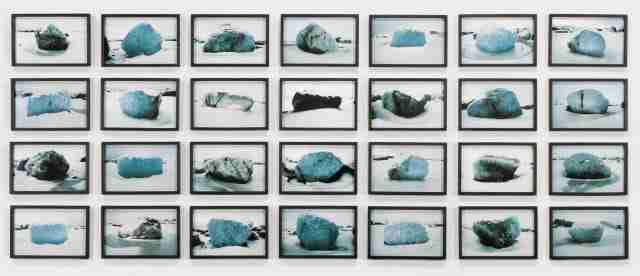
Serial art, characterized by the repetition of uniform elements or objects according to strict modular principles, is a major approach in contemporary art. It privileges systematic processes and explores consistency, process, and the passage of time. By looking at its origins, techniques, and key figures, we can understand how serial art reshaped what modern art could be.
Historical context and origins
Serial art emerged in the mid-20th century, in a period marked by rapid social, cultural, and technological change. In the postwar era, many artists moved away from the emotional intensity of Abstract Expressionism and toward practices that emphasized order, minimalism, and conceptual thinking. Serial art fits inside this shift: structured, rule-based, and open to variation within constraints.
An early precedent is Constantin Brancusi’s Endless Column, where repeated forms generate a sense of continuity and infinity. That logic, repetition as a method that produces meaning, becomes central for later serial practices.
Overview of serial art
Serial art involves producing multiple objects (paintings, sculptures, drawings, prints) in sets or series, often guided by systematic or even mathematical rules. One well-known model is Josef Albers’ square paintings, where a repeating structure generates a series of variations. This approach became strongly associated with Minimalism, the “multiple,” and “ABC art,” in which the work’s intelligence often lies in the rule and its consequences rather than in expressive gesture.
Another type of serial art can be considered even more strictly “serial” because it relies on a non-hierarchical sequencing of equivalent elements. Meaning appears through relationships across the set, not through any single privileged image. In this sense, serial structures can resemble music sequences, like a twelve-tone row. Examples include Max Bill’s Fünfzehn Variationen über ein Thema (1934 to 1938) and works by Richard Paul Lohse such as 30 vertikale systematische Farbreihen in gelber Rautenform (1943 to 1970) and Konkretion III (1947).

Key figures and contributions
Sol LeWitt, a key figure in Conceptual Art and Minimalism, expanded serial art through modular structures and wall drawings. For LeWitt, the idea and the system matter more than the handcrafted “finish.”
“The serial artist does not attempt to produce a beautiful or mysterious object but functions merely as a clerk cataloguing the results of his premise.”
Frank Stella brought serial logic into painting through repetition, rhythm, and constraint, especially in the Black Paintings and the Protractor Series. His focus on structure and visual fact, often summarized by the line “What you see is what you see,” aligned with serial art’s insistence on process and perception rather than narrative.
Techniques and processes
Serial art uses a small set of recurring strategies to generate meaning through accumulation:
- Repetition: a form or motif repeats across the series, making variation (or the refusal of variation) legible.
- Modularity: interchangeable units can be rearranged, combining control with flexibility.
- Iteration: each work in a sequence develops from the previous, emphasizing gradual change over time.
- Systematic methods: predetermined rules (and sometimes algorithms) guide production, foregrounding procedure.
Themes and concepts
- Time and process: each piece is a “moment” inside a larger continuum, and the full work often lives at the scale of the series.
- Perception and experience: subtle differences, patterns, and rhythms sharpen attention and create a meditative effect.
- Order and chance: systems suggest control, but variation introduces unpredictability and drift.
- Conceptual emphasis: serial art often shifts value away from expression and toward structure, logic, and method.
Impact on contemporary practice
Serial art’s influence is visible across Minimalism, Conceptual Art, and Process Art, and it continues to shape how artists think about authorship and originality. The series can function like a laboratory: a premise is tested across time, scale, and variation.
Contemporary artists influenced by serial art
- Damien Hirst: spot paintings and medicine cabinets echo serial methods, repetition, and production rules.
- Yayoi Kusama: repetition becomes immersion, and pattern becomes a psychological and spatial environment.
- Olafur Eliasson: repeated structures and calibrated systems build perception-based experiences.
Conclusion
Serial art, with its focus on repetition, variation, and process, has significantly shaped contemporary art. By challenging traditional ideas of originality and authorship, artists such as Andy Warhol, Sol LeWitt, and Frank Stella helped establish new ways of making that prioritize ideas and systems. The movement’s attention to time, perception, and order still resonates because it trains viewers to read structure, not just image.


