

Algorithmic Expressionism and AI Art: What Happens When Images Become Infinite?
Generative AI’s most disruptive contribution to art may not be its ability to produce images. It is its ability to make image production abundant. Once thousands of visual possibilities can be generated, discarded and regenerated in minutes, the old question “can a machine make art?” begins to look strangely inadequate.
The more difficult question is what happens to artistic value when making the image is no longer the scarce part of the process.
I have written elsewhere about the broader crisis of creativity produced by AI art. Here I want to push the argument further. If machines can generate convincing visual material almost endlessly, authorship does not disappear. It moves. It migrates from execution toward intention, selection, refusal, context and, ultimately, responsibility.
I use the term Algorithmic Expressionism for this possible condition. Not as the announcement of another art movement, and certainly not as an attempt to manufacture a label before history has done its work. It is a provisional critical term for a change that is already visible: expression increasingly emerges from a negotiation between human intention and computational possibility.
The important question is no longer whether the machine can produce an image. It is who takes responsibility for turning one of those images into an artwork.
The Image Is No Longer the Scarce Thing
For much of art history, producing an image required access to materials, training, time and physical labour. Photography weakened part of that equation. Digital tools weakened it further. Generative AI changes the scale again because variation itself becomes cheap.
A system can offer fifty alternatives where a painter might once have produced five sketches. It can alter composition, atmosphere, texture or visual language almost immediately. But multiplication does not automatically create artistic significance. In fact, abundance creates a new problem: when almost anything can be produced, why should this particular image exist?
This is where much contemporary discussion of AI art still becomes distracted. Technical achievement is repeatedly mistaken for artistic consequence. A spectacular output is treated as evidence of creativity simply because it would have been difficult to produce manually. Yet difficulty and artistic value have never been the same thing.
The distinction matters more now because the supply of spectacle is effectively limitless.
Algorithmic Expressionism Is Not a Visual Style
Expressionism historically connected formal distortion to an insistence on subjective experience. What I am calling Algorithmic Expressionism operates differently. It does not require a recognizable aesthetic. There are no mandatory colours, distorted bodies or digital textures. Its defining characteristic would be the relocation of expression inside a system of choices.
The artist establishes conditions. The model proposes possibilities. The artist accepts some, rejects most, alters others, introduces external material, changes the parameters, interrupts the process and eventually decides that something deserves to leave the private space of experimentation and enter public space as an artwork.
Seen in this way, the prompt is not the work. Neither is the raw output.
The artwork begins to emerge from the chain of decisions around them.
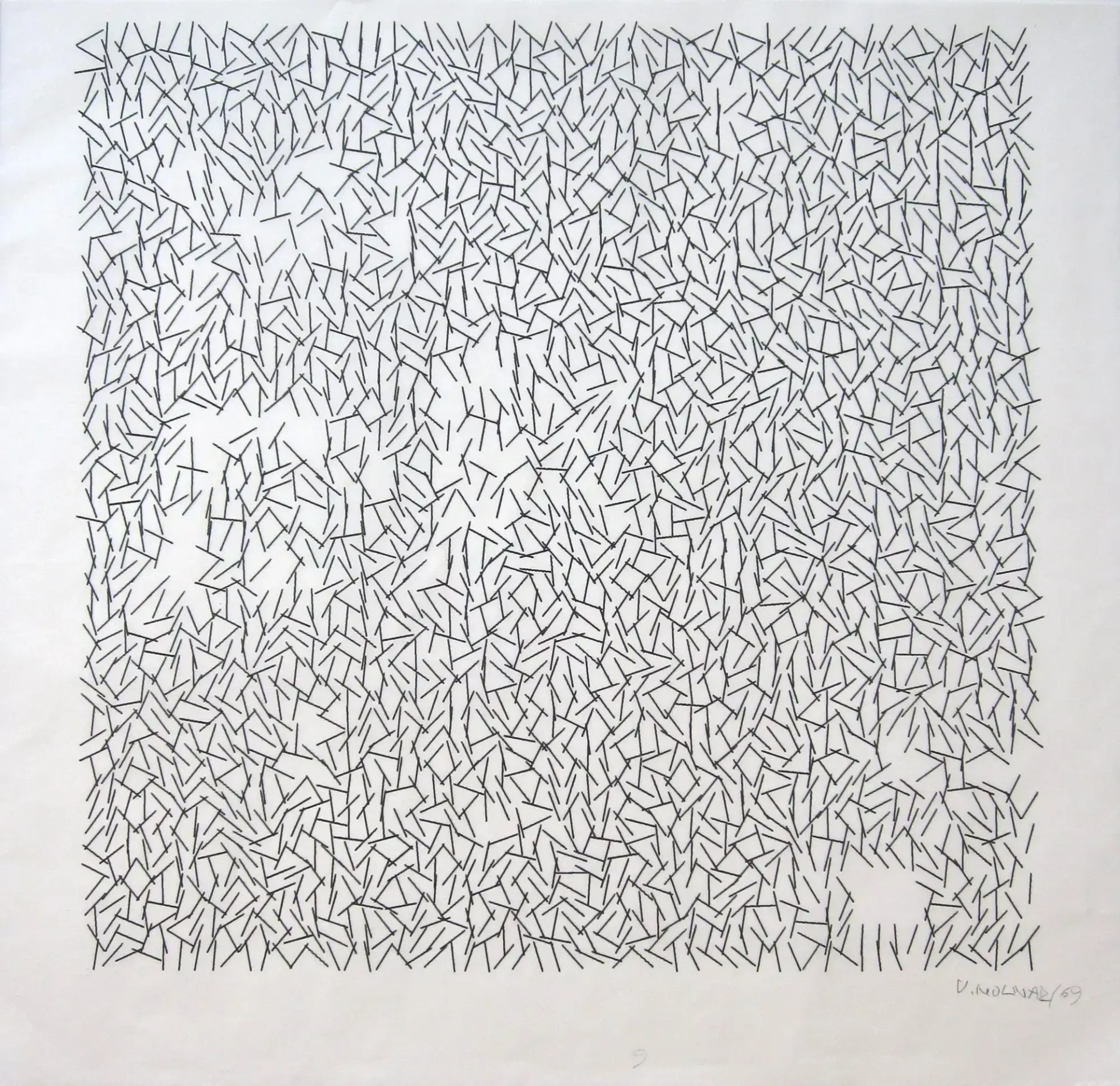
This does not make AI fundamentally unprecedented. The history of algorithmic art is much older than contemporary generative models. Artists and programmers have been exploring the relationship between rules, chance and computation since at least the 1960s. The Victoria and Albert Museum’s historical survey Chance and Control: Art in the Age of Computers, for example, placed Frieder Nake, Vera Molnár, Harold Cohen, Manfred Mohr and others inside more than half a century of computer-generated art.
Generative AI did not therefore introduce the machine into an empty studio. What it changed was access, speed, scale and cultural visibility.
From Making to Choosing
When production becomes abundant, selection becomes more visible.
This is why I find the fantasy of the autonomous artificial artist less interesting than the structures surrounding it. My earlier analysis of AICAN and the myth of the artificial artist leads to precisely this problem. A system may generate images, but people still select datasets, construct models, choose outputs, give works titles, determine formats, write descriptions, organize exhibitions and place objects inside the institutional machinery that recognizes something as art.
The apparent disappearance of human authorship can therefore conceal an enormous amount of human authorship.
This also explains why the legal debate has moved beyond the simplistic opposition between “human” and “machine.” In its 2025 report on AI and copyright, the U.S. Copyright Office concluded that AI-assisted work may qualify for copyright protection when a human author has determined sufficient expressive elements, while prompting alone does not automatically provide that authorship.
The law is not an aesthetic theory, but the distinction is revealing. It redirects attention away from the existence of the machine and toward the character of human intervention.
Authorship Is Becoming a Question of Responsibility
There is, however, a danger in describing the artist simply as a curator of machine outputs. Curation can become another convenient way of making responsibility disappear.
A generative system is not culturally neutral. It is constructed through infrastructures, datasets, computational labour, corporate decisions and enormous repositories of pre-existing cultural production. The question “who made this?” therefore becomes inseparable from other questions. What material entered the model? Whose work became training data? Which cultural assumptions were amplified? Which were flattened? Who owns the system and who profits from its circulation?
UNESCO has increasingly identified cultural data, copyright and the protection of creators as central problems created by generative AI. The difficulty is not merely technical. The technology forces us to decide whether culture should be treated primarily as an inexhaustible reservoir of machine-readable material or as a field of human relationships, histories and rights. UNESCO’s recent work on digital technologies and culture makes that tension particularly visible.
This is where Algorithmic Expressionism becomes more interesting to me. Expression can no longer mean only what an image seems to communicate. It must include the conditions that allowed the image to exist.
Recommended reading
Creative Machines: AI, Art & Us by Maya Ackerman examines the history, possibilities and limitations of creative AI, and argues for understanding it as a means of expanding rather than simply replacing human creativity.
As an Amazon Associate I may earn from qualifying purchases.
The Art Market Has Already Moved Beyond the Hypothetical
There is another reason to abandon the language of distant technological prophecy. AI art has already entered the institutional and commercial system.
In 2025, Christie’s organized Augmented Intelligence, which it described as the first auction at a major auction house dedicated entirely to art created with artificial intelligence. The sale included figures such as Harold Cohen, Refik Anadol, Holly Herndon and Mat Dryhurst, Claire Silver, Pindar Van Arman and Alexander Reben.
That event did not settle whether AI-generated work is good art. Markets are remarkably capable of selling things before criticism has worked out what they mean. What it demonstrated was something more concrete: AI art no longer exists outside the mechanisms that produce artistic legitimacy and economic value.
Once a generated object has an artist, a title, an edition, a provenance, a gallery, an auction estimate and a collector, the question is no longer whether the art world will accept AI. Parts of the art world already have.
The question becomes what criteria criticism should use now that technological novelty is no longer sufficient.
The Singularity Is the Wrong Question for Art
The technological singularity remains a useful thought experiment. It describes a hypothetical point at which artificial intelligence becomes capable of accelerating its own development beyond ordinary human control. But as a framework for thinking about art, it can also distract us.
It invites us to imagine a future machine so powerful that human creativity becomes obsolete. This produces excellent headlines and weak criticism.
Art has never depended only on technical superiority. A camera can reproduce appearances more quickly than a painter. A printer can repeat an image more accurately than a hand. A computer can calculate forms that no person could comfortably construct unaided. None of these facts eliminated the need for artists because art does not derive its value from being the most efficient available method of producing visual information.
Even a hypothetical machine capable of generating billions of technically flawless images would therefore leave a stubborn problem unresolved: which image matters, to whom, under what circumstances, and with what consequences?
The machine may increase the number of possible answers. It does not remove the need to ask the question.
When Everything Can Be Seen, Meaning Becomes More Expensive
AI intensifies a condition already visible across contemporary art in the 2020s: cultural production is increasingly organized by visibility. Images compete inside feeds, search engines, recommendation systems and attention markets that reward immediate recognition.
Generative AI adds almost unlimited supply to this already saturated environment.
That may produce an unexpected reversal. Handwork, slowness, material difficulty and physical presence could become more valuable precisely because they are unnecessary. Not because manual production is morally superior to computation, but because scarcity changes meaning. A hand-built object in a culture of instant synthetic production makes a different claim from the same object made before such production existed.
The same applies to AI art. The interesting work will not necessarily be the work that looks most artificial or demonstrates the newest model. It may be the work in which the use of AI is necessary to the argument being made.
Technology alone is not a position.
From Output to Consequence
Two years after first writing about Algorithmic Expressionism, I am less interested in predicting what AI art will look like than in asking what it will demand from artists.
The answer may be uncomfortable. When generating becomes easy, artists lose one of the oldest protections available to them: the difficulty of making. Technical complexity can no longer guarantee significance. Novelty will expire faster. Visual astonishment will become cheaper. The artist will have to account more clearly for why a work exists and what follows from putting it into the world.
This is why I would now define Algorithmic Expressionism not as expression produced by an algorithm, but as expression negotiated through an algorithm and made accountable by a human position.
The distinction is small in language and enormous in consequence.
The future of AI art will not be decided by whether machines eventually learn to imitate everything artists can do. They probably do not need to. The decisive change has already begun: machines can produce more images than culture can meaningfully absorb.
From this point on, creation is only the beginning.


