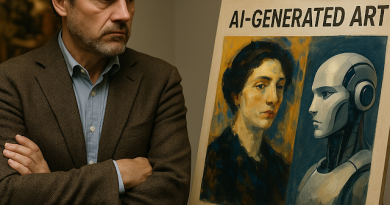
Mario Klingemann: Decoding the Intersection of Art, Technology, and Human Perception through AI
Mario Klingemann: AI art between code and human emotion
In the rapidly evolving landscape of art and technology, Mario Klingemann stands out as a visionary whose practice has reshaped how we understand artificial intelligence as a creative medium. Known in the art world as “Quasimondo,” he bridges the binary logic of code and the messy, affective sphere of human perception, working in the tension between resemblance and invention.
A deep dive into Klingemann’s artistic process
Klingemann’s work is not a decorative fusion of technology and art history. Instead, it is an inquiry into pattern recognition, neural networks, and generative systems. His process often begins by shaping a model’s constraints. Then, he trains it on large image corpora so it can learn visual habits and break them. The results can feel historically “legible,” yet they remain unmistakably synthetic. They expose the seams of machine perception.
Pioneering projects: a closer look
Memories of Passersby I is among Klingemann’s most recognized installations. It generates faces in real time: convincing, haunted, and fundamentally untraceable to any actual person. The work turns portraiture into an algorithmic event. It asks what identity means when likeness can be manufactured endlessly.
With Neurography, Klingemann pushes neural systems toward high-resolution reinterpretations that often lean into abstraction and surreal drift. The images can be read as a speculative window onto how machines “see,” but also as a critique of our desire to anthropomorphize AI into a mind that mirrors our own.
Ethical dimensions of AI art
Klingemann’s work naturally triggers ethical questions about authorship, originality, and cultural inheritance. If a model is trained on historical images, what kind of “memory” is that, and who benefits from it? Klingemann’s position, broadly, treats AI as a medium and a tool. It serves as an extension of artistic intent rather than a replacement for human creativity.
Broader impact and philosophical implications
Beyond aesthetics, Klingemann’s installations often become platforms for debate about privacy and surveillance. They also question the autonomy we project onto artificial systems. The works do not simply showcase technical possibility. Instead, they stage a public confrontation with the social consequences of generative technologies.

Exhibitions and global recognition
Klingemann’s work has circulated widely through major platforms for media art and contemporary culture, often presented as interactive encounters rather than static displays. Viewers are invited to witness the system’s behavior, leaving with questions about where creativity “sits” when a machine can generate endlessly.
Collaborations and interdisciplinary work
Klingemann frequently collaborates across fields, reflecting the interdisciplinary nature of AI art. These exchanges can function like a studio expanded into research, where artistic questions and technical methods pressure-test each other.
Future directions and ongoing innovations
Looking forward, Klingemann continues to experiment with emerging technologies and new methodologies. He explores how generative systems might respond to context, interpretation, and human presence in more adaptive ways.
A legacy in the making
Klingemann’s impact lies not only in the works themselves, but in the conversations they trigger about the boundaries between human and machine, artist and artifact, intention and automation. In an era where AI is increasingly embedded in everyday life, his practice keeps the creative and ethical stakes visible. It insists that technical power is never culturally neutral.