Everyone Cried for This Robot. But It Was Never Dying
Sun Yuan and Peng Yu’s Can’t Help Myself became the internet’s favourite dying machine. The story was false. What the
Read More
Robotic art uses machines, sensors, programmed movement and automated systems as artistic materials. Rather than treating the robot as a simple tool, artists turn it into a performer, collaborator, controlled body or unsettling representation of technological power.
From the early cybernetic experiments of Nicolas Schöffer and Edward Ihnatowicz to the performances of Stelarc and contemporary installations by Sun Yuan and Peng Yu, robotic art has questioned autonomy, labour, surveillance and the increasingly unstable boundary between human intention and mechanical behaviour.
Works such as Can’t Help Myself demonstrate why robotic art produces such strong emotional responses. Viewers project exhaustion, fear and vulnerability onto programmed movements, while the machine exposes the systems of control, observation and repetition that organise contemporary life.
Robotic art is related to digital and artificial intelligence practices, but the terms are not interchangeable. A robotic artwork may use physical automation without artificial intelligence, while AI art can exist entirely through software and generated images. This archive collects articles and critical readings on robots, kinetic installations, automation, machine behaviour and the politics of human and technological interaction.
 Sun Yuan e Peng Yu - Can’t Help Myself (2016)
Sun Yuan and Peng Yu’s Can’t Help Myself became the internet’s favourite dying machine. The story was false. What the
Read More Sougwen Chung
: visionary artist and researcher Sougwen Chung is an artist and researcher whose work spans drawing, sculpture, installation,
Read More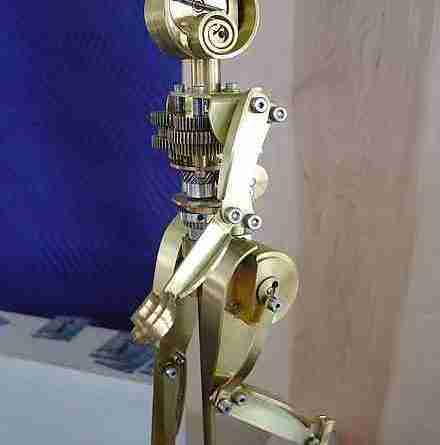 Mark Galt — Mechanical Woman Walking
Robotic Art: From Automata to Interactive Sculptures That Watch You Back Robotic art sits where contemporary art gets uncomfortable in
Read More