The New York School: Defining Abstract Expressionism
Revolutionizing the Art World The New York School, also known as Abstract Expressionism, emerged in the late 1940s and early
Read More
Jackson Pollock (1912–1956) was an American painter and one of the most recognisable figures of Abstract Expressionism and the New York School. His poured paintings transformed the canvas from a surface for representing images into a physical field recording movement, rhythm, gravity and artistic decision.
During the late 1940s, Pollock began placing large unstretched canvases on the studio floor. He applied liquid paint with sticks, hardened brushes, trowels and containers, dripping, pouring and throwing it from different directions. The resulting compositions may appear chaotic, but they were not produced through uncontrolled accident. Pollock repeatedly adjusted his position, speed and gestures to build dense networks of lines without a conventional centre or hierarchy.
This approach became closely associated with Action Painting. Like Willem de Kooning, Pollock treated painting as a sequence of actions and revisions. His spatial rhythms also reflect questions explored by Hans Hofmann, although Pollock replaced Hofmann’s coloured planes with continuous linear movement. His work represents a different tendency from the large chromatic surfaces of Color Field Painting.
Pollock’s paintings shifted attention from the final image to the process of its creation, influencing performance, installation and later forms of process-based art. His inclusion among the Abstract Imagists also reflects how his all-over structures could become unified images in their own right. This tag gathers articles, exhibition reviews and critical perspectives on Jackson Pollock, his techniques, mythology and lasting impact on contemporary art.
 Barnett Newman - Who's Afraid of Red, Yellow and Blue IV
Revolutionizing the Art World The New York School, also known as Abstract Expressionism, emerged in the late 1940s and early
Read More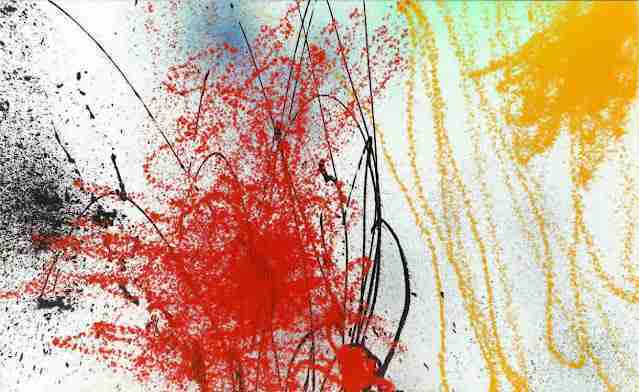 Hans Hartung - Untitle
Tachism: Postwar Paris and the Lyrical Politics of the Brushstroke In the wake of World War II, the art world
Read More Josef Albers – Memento
Abstract Imagists: Symbols, Color Fields, and the Power of Simplified Form The term “Abstract Imagists” comes from a pivotal 1961
Read More