Bridget Riley: Mastering the Art of Perception with Op Art
Bridget Riley: Master of Optical Art and Visual Perception Bridget Riley stands as a central figure in Op Art, a
Read More
Bridget Riley is a British artist whose paintings transform optical perception into an active and unstable experience. Through repeated lines, geometric structures, tonal contrasts and precisely organised colour, Riley creates surfaces that appear to vibrate, expand and move beyond the limits of the canvas.
Emerging as a central figure of Op Art during the 1960s, Riley initially worked in black and white before developing increasingly complex relationships between colour, rhythm and spatial tension. Paintings such as Movement in Squares, Fall and Cataract 3 demonstrate how apparently simple visual systems can generate intense physical sensations.
Her work does not depict movement as an image. It produces movement through the viewer’s act of looking, making perception part of the artwork itself. The eye attempts to stabilise the composition while the painting continually resists that stability.
This archive collects articles and critical readings on Bridget Riley, Op Art, optical abstraction, colour, movement, perception and her continuing influence on contemporary painting and visual culture.
 Bridget Riley – Nataraja
Bridget Riley: Master of Optical Art and Visual Perception Bridget Riley stands as a central figure in Op Art, a
Read More Kinetic art example (image)
The Evolution and Impact of Kinetic Art: From Origins to Contemporary Innovations Kinetic art is a captivating genre that integrates
Read More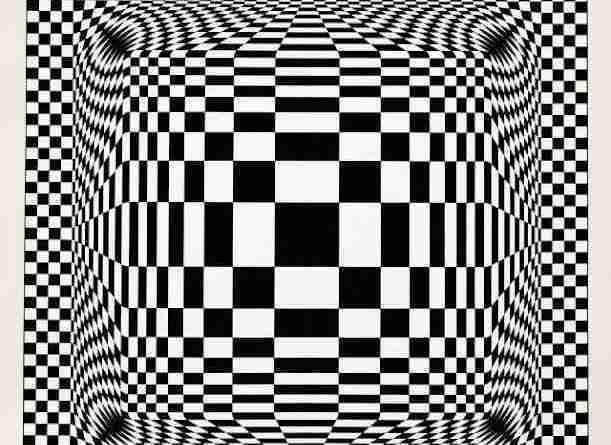 Victor Vasarely – Nora Dell
Nothing moves in an Op Art painting. That is the first thing to remember. Op Art: When a Still Image
Read More