The Dynamic World of Kinetic Art: Motion, Mechanism, and Meaning
The Evolution and Impact of Kinetic Art: From Origins to Contemporary Innovations Kinetic art is a captivating genre that integrates
Read More
Alexander Calder was an American artist who transformed sculpture by introducing movement, balance and instability into three-dimensional form. Best known for his suspended mobiles and monumental stabiles, Calder replaced the traditional idea of sculpture as a fixed mass with structures that respond to air, gravity and the surrounding space.
His early mechanical works, including Calder’s Circus, combined wire, performance and playful engineering. Marcel Duchamp later used the term “mobile” for Calder’s moving constructions, while Jean Arp proposed “stabile” for the artist’s stationary sculptures.
Calder’s work occupies a crucial position between abstraction, kinetic art, modern sculpture and public art. Simple geometric elements acquire unpredictable relationships as they move, demonstrating how an artwork can remain recognisable while never appearing in exactly the same configuration twice.
This archive collects articles and critical readings on Alexander Calder, his mobiles and stabiles, kinetic sculpture, movement, balance, public monuments and his continuing influence on contemporary art.
 Kinetic art example (image)
The Evolution and Impact of Kinetic Art: From Origins to Contemporary Innovations Kinetic art is a captivating genre that integrates
Read More Alexander Calder - Big Crinkly
Exploring the Legacy of Alexander Calder: The Revolutionary Artist Who Brought Movement to Modern Sculpture Pioneering Kinetic Art and Inventing
Read More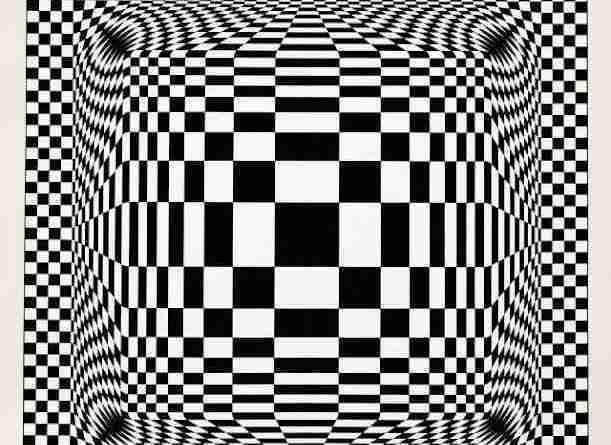 Victor Vasarely – Nora Dell
Nothing moves in an Op Art painting. That is the first thing to remember. Op Art: When a Still Image
Read More