Yayoi Kusama’s Tears at Frieze Seoul: When Mourning Becomes Market Value
Nothing about Portrait Yayoi-Chan changed between 21 August, when Frieze presented it as a highlight, and 2 September, when the fair opened in Seoul. Everything around it did.
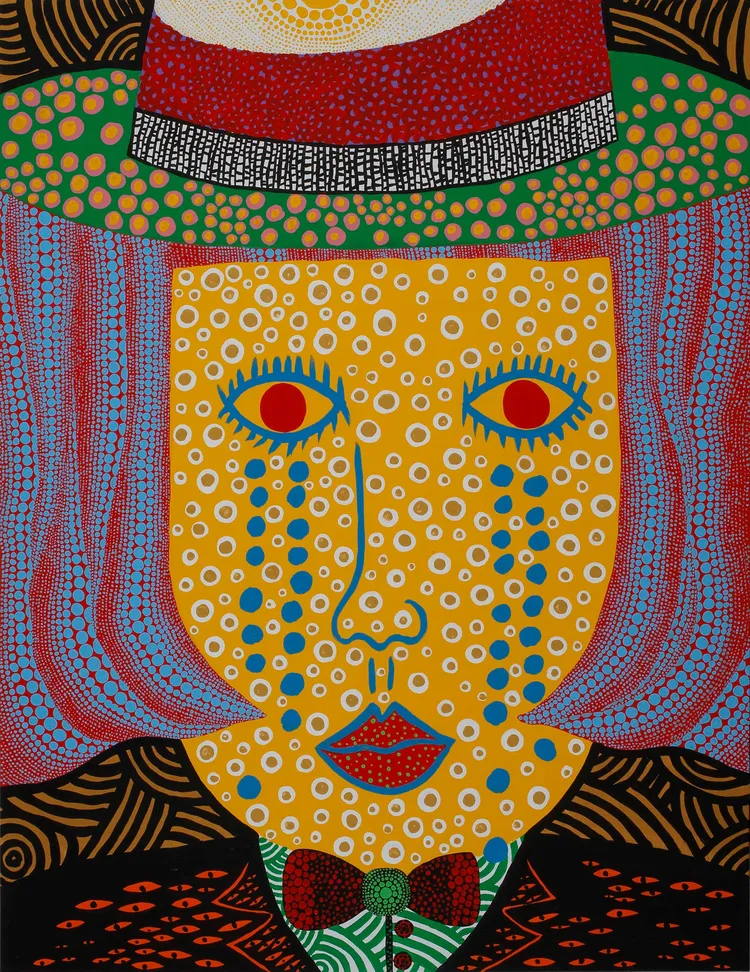
At booth A04, the face is difficult to escape. Yayoi Kusama bends her features into an unstable mask: one eye appears to drift from the other, the mouth tightens, and blue tears descend across a field of violent colour. Painted in 2014, Portrait Yayoi-Chan was always a self-portrait in which recognition threatened to come apart. At Frieze Seoul 2026, it arrived carrying a meaning it could not have possessed when Ota Fine Arts chose it.
Kusama died in a Tokyo hospital on 14 August 2026, aged 97. Her studio and museum announced her death on 27 August. Six days later, the fair opened, and a painting already selected as the anchor of Ota Fine Arts’ presentation became one of its most watched objects. The chronology matters. Frieze had identified the work in its preview published on 21 August, before the public announcement. This was not a cynical last-minute substitution. It is a more revealing case than that.
The gallery did not manufacture the coincidence. The market did not need to. Death altered the room by altering the people looking inside it.
A Painting Chosen Before It Became a Farewell
The responsible reading begins by refusing the easiest accusation. Ota Fine Arts announced a group presentation including Kusama months before the fair, and Frieze described Portrait Yayoi-Chan as its anchor while she was still publicly understood to be alive. The painting was not rushed to Seoul to exploit an obituary. Its position had already been decided.
Yet advance planning does not preserve an artwork inside its original context. A fair booth is not a sealed historical room. Meaning enters with the audience, and the audience at COEX arrived after reading that Kusama had died. They could no longer encounter a self-portrait by a living artist who continued to paint. They encountered one image inside a completed life.
This is the first transformation death produces, and it is not financial. It is grammatical. The present tense becomes the past. A practice becomes an oeuvre, activity becomes legacy, and the possibility of a next work disappears. Even an image made twelve years earlier begins to look terminal. Tears that once belonged to Kusama’s long vocabulary of psychic pressure can suddenly resemble premonition, goodbye or mourning.
That reading may be emotionally understandable, but it is not historically innocent. The painting did not predict the week of its display. Kusama did not make it for her own memorial. To treat every tear as a final message is to let biography overrule the artwork. Still, pretending that viewers can simply switch off the knowledge of her death would be equally false. The meaning has changed, even if the paint has not.
The Tears Were Already There
Frieze’s own description compares the facial distortion and symbolic tears in Portrait Yayoi-Chan to Picasso’s The Weeping Woman. The resemblance is useful, but Kusama’s portrait belongs to a different system of self-invention. “Yayoi-chan” is an intimate, diminutive form of her name. The title makes the global icon small again, almost childlike, while the image refuses the polished stability of a celebrity portrait.
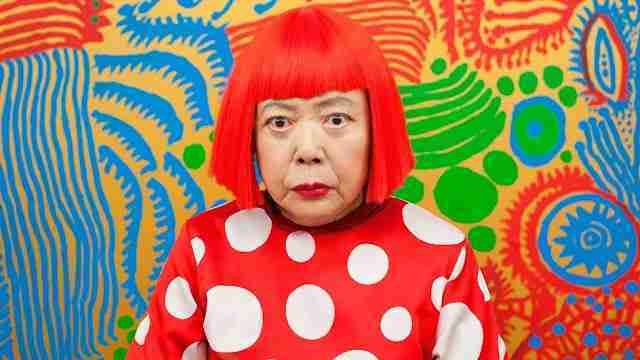
Kusama spent decades producing one of contemporary art’s most recognisable public identities: red wig, dotted clothing, pumpkins, mirrored rooms, the repeated face photographed beside the repeated object. It would be easy to dismiss this as branding, and parts of the art industry certainly learned to reproduce it with industrial efficiency. But the persona was never merely packaging. It was also armour, authorship and a way of controlling visibility after years in which a Japanese woman in the New York avant-garde could generate ideas without receiving equal historical credit.
Portrait Yayoi-Chan interrupts that control. The face does not sit calmly behind the brand. It fractures. Its tears prevent the self-portrait from becoming a logo, although the fair can still turn that fracture into a magnet. This is what makes the painting so uncomfortable in Seoul: private vulnerability and public recognisability occupy the same surface, while commercial attention gathers around both.
Mourning Changes Attention Before It Changes Price
The phrase “death effect” sounds brutal because it is. Art-market economics uses it to describe possible price changes after an artist dies and the supply of future works closes. Yet the research is less tidy than the folklore. Some studies test for a legacy premium, while historical auction research has also found posthumous declines linked to changes in dealers, expertise and patterns of sale. Death is not an investment formula. Reputation, supply, authentication, estate management, provenance and quality all intervene.
Kusama was not an obscure artist waiting for death to create scarcity. She was already a global museum phenomenon and a major commercial force. Phillips sold her 1959 painting Untitled (Nets) for $10.496 million in 2022, then an auction record for the artist. Her market existed at scale before the obituary, supported by museums, galleries, editions and an image-world recognisable far beyond specialist collecting.
That is why the most interesting change at Frieze Seoul cannot yet be measured by a higher number on a sales sheet. The change is visible in the concentration of looking. Visitors pause longer. Phones rise. Conversations acquire a new urgency. A work that was already important becomes an event because history has entered the booth between selection and display.
Attention is not the same as price, but in an art fair it is never economically neutral. Attention produces photographs, press, memory and the reassuring sense that everyone else has also recognised importance. It creates the social evidence on which market confidence thrives. The conversion can begin before a sale, and sometimes before anyone is willing to admit that conversion is taking place.
From Infinite Production to a Finite Oeuvre
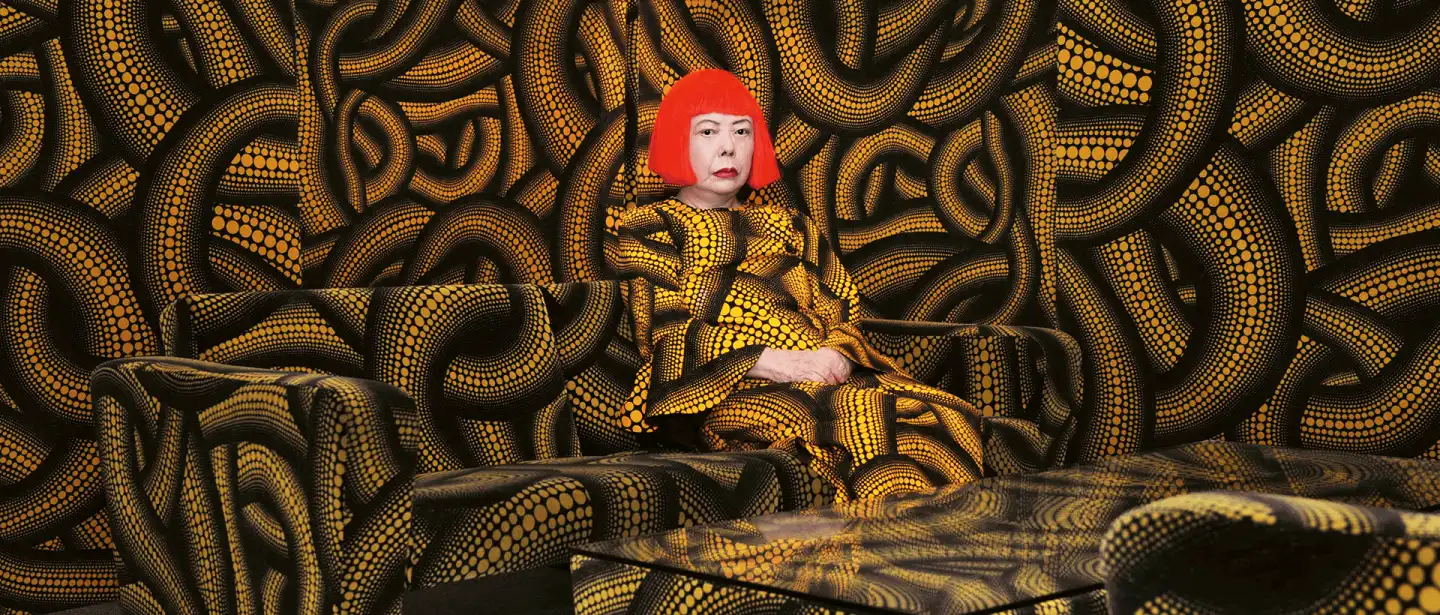
Kusama built a visual language around infinity: nets without apparent end, mirrored lights multiplying beyond the room, dots spreading until the individual body seemed to dissolve. Her death introduces a severe material counterpoint. The motifs may promise endlessness, but the oeuvre is now finite.
This does not mean the supply of Kusama objects simply stops. Editions remain in circulation, exhibitions continue, existing works return to auction, and authorised projects may extend the public life of her imagery. Nor does finitude make every object equally important. On the contrary, the work of the foundation, studio, galleries, museums and scholars becomes more consequential because they will help determine distinctions the market prefers to blur: major and minor, unique and editioned, radical and decorative, historical object and branded merchandise.
Collectors also begin to buy different kinds of time. While an artist is alive, acquisition contains a relationship to an unfolding practice. After death, it becomes a claim on a closed historical field. The buyer is no longer betting only on what the artist might do next. The buyer is positioning an object within what the artist is now understood to have completed.
This shift can sharpen scholarship, but it can also flatten a difficult career into a handful of liquid symbols. Kusama’s dots and pumpkins are highly transmissible. Her anti-war happenings, sexual politics, fiction, soft sculptures and institutional exclusion are less convenient. The market loves a legacy it can recognise across a crowded room. History should demand more.
A Fair Is an Accelerator, Not a Neutral Container
Frieze Seoul did not cause this transformation, but its architecture accelerates it. A fair compresses judgement. Hundreds of works compete for attention, collectors make rapid comparisons, and the apparently simple act of stopping at a booth becomes a public signal. In this setting, biography operates like a spotlight.
The effect is especially clear when read alongside the wider power moves shaping Frieze Seoul 2026. Elsewhere in the fair, the Korean queer collective Yagwang uses Facade Zone to dismantle the architecture of Frieze, although that dismantling is authorised and institutionally funded. At Ota Fine Arts, no wall needs to fall. Time itself destabilises the booth.
Both cases expose the same uncomfortable fact: an art fair does not merely sell objects. It organises the conditions under which contradiction becomes visible and valuable. Critique can become a sponsored attraction. Mourning can become concentrated attention. The fair is flexible enough to absorb both without resolving either.
This is part of the darker machinery of the contemporary art world, but it should not be reduced to a cartoon of greedy dealers and innocent viewers. Markets are powerful precisely because they work through ordinary human responses: curiosity, grief, admiration, fear of missing an important moment. No one has to announce that mourning is being monetised. The structure can translate feeling into value on its own.

Who Owns the Meaning of the Tears Now?
After an artist dies, interpretation becomes a struggle over custody. The estate protects authenticity and legacy. Galleries maintain markets and relationships. Museums stabilise art-historical importance. Auction houses produce public price signals. Journalists establish the first version of the obituary, and audiences bring intimate memories to images they may have known for decades.
Kusama’s case intensifies that struggle because her work already moved between avant-garde resistance, mass participation and luxury culture. Her career cannot be honestly told as either triumphant liberation or total commercial capture. She used repetition to make psychic experience visible, and the market used repetition to make her endlessly recognisable. Both statements are true.
The task now is not to rescue a pure Kusama from commerce. Such purity never existed. In 1966, outside the Venice Biennale, she attempted to sell mirrored balls from Narcissus Garden under a sign offering visitors their narcissism for sale. The friction between transcendence and transaction was not added to her work at the end. It was there near the beginning.
But Frieze Seoul reveals a new threshold. Kusama can no longer answer the institutions, brands and markets that will speak through her image. The responsibility of looking therefore increases. Viewers should be allowed to mourn, but mourning should not become an excuse to stop interpreting. Collectors may desire the work more intensely, but intensity is not proof of understanding.
The Market Sees the Same Painting Differently
The question is not whether Ota Fine Arts exploited Kusama’s death. The available chronology argues against that claim. The sharper question is what happens when an innocent curatorial decision enters a market newly charged by loss.
Portrait Yayoi-Chan became the right image at the wrong time, or perhaps the wrong image at exactly the time the fair could not avoid. Its tears now seem to address an event they predate. Its distorted face carries the pressure of farewell. Its market visibility grows because viewers know there will be no future Kusama capable of revising the story.
Nothing on the canvas changed. The supply did not visibly contract at the booth. No auction result was required. Yet the work became scarcer in the imagination, heavier in history and more urgent to possess, photograph or remember.
That is how mourning becomes market value. Not through a villain’s decision, but through a collective change of tense.
Recommended Reading
Frieze A to Z of Contemporary Art
A useful companion for navigating the artists, movements, institutions and language that shape contemporary art.
Affiliate disclosure: this article contains an affiliate link. If you make a purchase through it, I may earn a commission at no additional cost to you.
- Frieze Seoul 2026: The Artists, Galleries and Power Moves That Actually Matter
- Frieze Pays Artists to Dismantle Frieze: Yagwang’s Facade Zone
- The Dark Side of the Art World
- Art Trends 2026: Institutional Power, Market Realism, and the Politics of Cultural Value
- Maurizio Cattelan’s Comedian: A Critical Analysis