
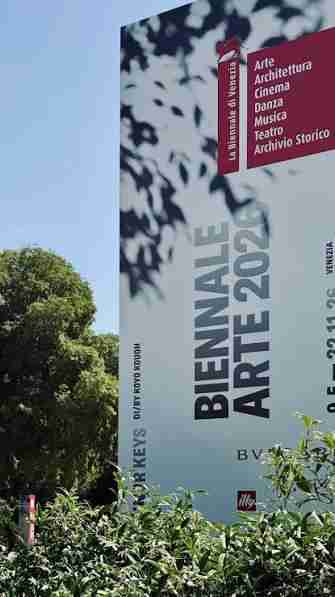
Who Will Win the Venice Biennale 2026 Visitors’ Lions? My Predictions After Three Visits
The jury is gone, more than one hundred participants have challenged the system that replaced it, and thousands of visitors are now deciding the two major awards of the 2026 Venice Biennale. After the preview, two return visits and months of conversations with artists, curators, journalists and visitors, I have my predictions. But the more interesting question is what this new voting system is actually measuring.
I have now been to the 2026 Venice Biennale three times. I was there during the preview, when the Giardini and Arsenale still had that peculiar mixture of exhaustion, adrenaline, press access and professional theatre that makes people look at art while simultaneously looking over each other’s shoulders. I returned twice afterwards, when much of that machinery had disappeared and the Biennale had become closer to what most visitors actually experience: long hours of looking, walking, forgetting and occasionally being stopped by something that refuses to leave.
In the months since, I have remained in contact with several of the artists, curators and journalists I met in Venice. I also started asking visitors a simple question whenever the new Visitors’ Lions came up: who do you think will win? When possible, I followed it with another: who did you actually vote for? This is not an exit poll. I did not construct a representative sample or collect data that could legitimately be converted into percentages. But those conversations have become part of my reading of the exhibition, alongside my own three visits, the critical reception of individual projects and the increasingly strange system through which the 2026 Biennale will decide its prizes.
This article is also part of a much longer project. During the closing days of the Biennale, I will publish a book on the 2026 edition in two separate editions, one in English and one in Italian. The English edition is titled I Saw It All. I Remember Almost None of the Art.; the Italian edition will be published separately for Italian readers. Both grow out of months of visits, interviews, notes, encounters and details that usually disappear once the opening week is over. You can explore both editions and read a free preview now.
Because the experiment taking place in Venice is much more interesting than a competition between artworks. The Biennale has effectively replaced judgement with voting, and those two operations are not the same thing.
Venice Biennale 2026 — At a glance
Awards: two Visitors’ Lions — one for a participant in In Minor Keys, one for a National Participation.
Voting: open to ticket holders who have visited both Giardini and Arsenale.
Awards ceremony: 22 November 2026.
My current prediction: Japan for National Participation; Wangechi Mutu for In Minor Keys.
My own winners: the accidental “Pavilion of Nature” and Semyon Skrepetsky.
How the Venice Biennale Ended Up Without a Jury
The rupture came before the public opening. On 30 April, the five members of the International Jury appointed by the late artistic director Koyo Kouoh — Solange Farkas, Zoe Butt, Elvira Dyangani Ose, Marta Kuzma and Giovanna Zapperi — resigned. La Biennale officially confirmed their collective resignation and responded by establishing two new awards, the Visitors’ Lions, with the ceremony moved to 22 November, the final day of the exhibition.
The result is unprecedented for this edition. Instead of the normal specialist jury deliberating over the central exhibition and national pavilions, one Visitors’ Lion will go to a participant in Koyo Kouoh’s In Minor Keys and another to a National Participation. The Golden Lions for Lifetime Achievement will not be awarded in 2026 because Kouoh had not finalised those selections before her death.
Voting itself is more controlled than the phrase “public vote” might suggest. Only ticket holders who have visited both Giardini and Arsenale can participate. Their visits are verified through the ticketing system; after entering the second venue, eligible visitors receive an email link and can cast one anonymous vote in each category. The Biennale’s voting rules therefore define “the public” quite narrowly: not everyone who sees the Biennale, but the subset of visitors who complete both principal venues.
That qualification already creates an interesting problem. Democracy begins only after the institution has decided who belongs to the electorate.
Democratisation, or the Populism of Looking?
A jury prize and a popular prize do not simply ask different people to answer the same question. They inevitably create different criteria. A professional jury can return to an austere installation, debate its historical significance, examine the relationship between concept and form and compare a work that initially appeared minor with something spectacular encountered hours earlier. A public vote takes place under different conditions. After seven hours at the Biennale, perhaps after hundreds of works and kilometres of walking, what remains available when the voting email arrives the following day?
The answer is often not an argument but an image. You remember what stopped you, what frightened you, what you touched, what produced a queue, what made somebody beside you laugh, what another visitor insisted you could not miss. You remember an immersive room differently from a textual work, and you may remember an artwork you photographed differently from one you respected intellectually but never wanted to see again.
This does not mean that the public is incapable of complexity, nor that visibility automatically produces superficiality. That would simply reproduce the old hierarchy according to which specialists understand art while everybody else merely consumes it. The real issue is subtler: once an award is determined by thousands of individual recollections rather than by collective deliberation among specialists, memorability becomes structurally more important. The 2026 Visitors’ Lions are therefore also an experiment in the economy of attention.
This is not a minor theme within my own reading of the Biennale. Across the Venice Biennale 2026 archive on The Art Trace, I have repeatedly returned to visibility, institutional power and the difference between being seen and producing consequence. The new prize system makes those questions measurable in an unexpectedly literal way.

Instagram Is Not the Problem. Attention Is.
It would be easy to describe the Visitors’ Lion as an Instagram prize. It would also be too simple. Some of the most photographable projects in Venice are sophisticated works, and an artwork does not lose intellectual substance because visitors want to photograph it. What changes is the competitive value of circulation. A work that can be compressed into one extraordinary image travels faster than a complex installation requiring twenty minutes and four pages of context. An immersive room can become familiar before somebody physically enters it, while a queue produces its own publicity: visitors see other people waiting and infer that something important must be happening inside.
For years contemporary art has analysed the attention economy from a critical distance. The Biennale has now inadvertently converted that economy into part of the mechanism through which an official prize will be produced. Social media is only one part of it. Placement matters. Scale matters. The architecture of the pavilion matters. Whether the artist appears more than once matters. Whether a visitor already knows the artist’s name matters. Even the point at which a work appears during the exhausting Giardini–Arsenale route can change its ability to survive in memory.
A Ballot Full of Candidates Who Do Not Want the Prize
Then there is the largest distortion of all. More than one hundred participating artists and pavilion representatives publicly challenged the new Visitors’ Lions and requested withdrawal from consideration. The dispute escalated when participants argued that their names should disappear from the ballot altogether. The published withdrawal statement includes major figures from the central exhibition and representatives of numerous national pavilions.
Among the In Minor Keys signatories are figures who would otherwise belong naturally in any serious conversation about possible winners: Alfredo Jaar, Otobong Nkanga, Walid Raad, Laurie Anderson, Tuan Andrew Nguyen, Annalee Davis, Guadalupe Maravilla, Zoe Leonard, Tabita Rezaire, Alice Maher, Carolina Caycedo and Sohrab Hura, among many others. National teams connected to Britain, Italy, France, Austria, Spain, the Netherlands, Poland, Switzerland, Denmark, Ukraine, Ireland, Belgium, Portugal, New Zealand, Türkiye and other pavilions also joined the protest.
This matters enormously for any prediction. Several of the presentations that might plausibly have attracted either critical support or substantial public attention are therefore part of a contested category. The Biennale has maintained the names in the voting interface while stating that votes for participants who withdrew will not determine the awards. I examined that contradiction in detail in The Prize Nobody Wants: Venice Biennale 2026 and the Collapse of Neutrality.
The final result consequently cannot be read as a clean ranking of the Biennale’s best work. It will emerge from a field already reshaped by refusal. Visitors are being invited to exercise agency at precisely the moment when some of the artists are attempting to exercise the opposite agency: the right not to be chosen.

The book behind this article · Free preview
I Saw It All.
I Remember Almost None of the Art.
This article predicts what visitors may remember. The book asks what remained with me after months of Venice: the artworks, the people outside the frame, and my own desire to be seen.
Coming in separate English and Italian editions. Choose your language and read the free presentation and excerpt.
The Soft Gerrymandering of Attention
I use the term gerrymandering metaphorically here; I am not suggesting vote tampering or electoral fraud. What exists instead is a geography of attention that was never designed to be neutral and becomes more consequential once attention is converted into votes.
A permanent pavilion in the Giardini begins with an enormous structural advantage over a national participation hidden elsewhere in Venice. A monumental installation has different conditions of visibility from a quiet conceptual work. An artist positioned near the entrance or at the culmination of the Arsenale benefits from a role almost comparable to punctuation: the work tells the visitor that something has begun or that something is ending.
There is then the communications infrastructure surrounding the art. National pavilions have different PR budgets, press networks and institutional reach. Some generate hundreds of international articles, reels and interviews; others struggle to become visible beyond specialist publications. Once there is a public vote, effective communication acquires an additional potential function. It no longer merely brings people to the exhibition; it can also help preserve a name in visitors’ minds until the ballot arrives. No campaign needs to tell people explicitly what to vote for. Recognition, repetition and familiarity may be enough.
In a public contest, the artwork is therefore not competing alone. Its distribution system is competing too.
My Predictions for the 2026 Visitors’ Lions
These forecasts are not a ranking of artistic quality. They are predictions about a particular voting system. I am basing them on what I saw during three visits, what other visitors repeatedly mentioned to me, critical reception, memorability, physical placement, accessibility of the concept, social circulation and, crucially, the withdrawals that have altered the effective field.
| Award / position | Prediction | Why it has an advantage in a public vote | Main risk |
|---|---|---|---|
| Visitor Lion – National Participation | Japan — Ei Arakawa-Nash, Grass Babies, Moon Babies | Highly participatory, immediately recognisable, emotionally accessible and physically memorable. Visitors do not only see the work: they carry one of its baby sculptures. | Its playful appearance could lead some voters to privilege more overtly serious or political projects. |
| Strong alternative – National Participation | Germany — Sung Tieu / Henrike Naumann, Ruin | One of the critically strongest presentations, with an unusually coherent relation between architecture, German history, migration and memory. | It accumulates meaning slowly and may be less easily reduced to the single memorable image that helps in a popular vote. |
| Possible surprise – National Participation | Saudi Arabia — Dana Awartani | The reconstructed mosaics of damaged and destroyed sites create an immediate material image while retaining historical complexity. | Less participatory and less inherently social-media driven than Japan. |
| Another pavilion to watch | Brazil — Rosana Paulino / Adriana Varejão | Major artists, strong visual identity and an accessible relation between colonial history, the body and material wounds. | A very competitive field of visually powerful national presentations. |
| Structural outsider | Australia — Khaled Sabsabi | The artist is encountered both through the Australian Pavilion and within In Minor Keys, creating unusual name recognition across the two venues voters must visit. | Recognition does not necessarily convert into a vote. |
| Visitor Lion – In Minor Keys | Wangechi Mutu | A highly recognisable visual universe, substantial presence and the rare ability to make a group exhibition feel temporarily like her own world. | The central exhibition contains several monumental works capable of overwhelming individual recollection. |
| Strong alternative – In Minor Keys | Big Chief Demond Melancon | Monumentality, extraordinary craft, ceremonial force and one of the clearest visual icons of the exhibition. | Some visitors may remember the image more readily than the artist’s name when voting later. |
| Social / monumental candidate | Nick Cave | Large-scale works, strong placement and an immediately recognisable visual language give him a major memory advantage. | Spectacle may produce enormous attention without necessarily converting into a preference vote. |
| Conceptual candidate | Kader Attia | His installation rewards duration and remains one of the stronger conceptual environments at the Arsenale. | It resists compression into a single image, which may disadvantage it within a memory-driven ballot. |
| Wild card | Khaled Sabsabi | Repeated exposure across the Biennale could matter more than it would under a jury system. | His dual visibility is a structural advantage, not evidence of actual voting support. |
If somebody forced me today to write only two names and seal the envelope until 22 November, my forecast would be Japan for the National Participation and Wangechi Mutu for In Minor Keys. I would not describe either as “the best of the Biennale” simply because they eventually won. A Visitors’ Lion will tell us something fascinating about what the 2026 audience retained, but retention and artistic consequence remain different questions.

Why Japan Is Built for This Particular Prize
Ei Arakawa-Nash’s Japanese Pavilion may be the clearest example of how the voting mechanism changes the analysis. Grass Babies, Moon Babies allows visitors to pick up and carry baby-like sculptures, transforming the relationship between viewer and object from observation into temporary responsibility. The project connects queer parenthood, care, demographic anxiety and broader questions around family, belonging and history, yet it does so through a mechanism that can be understood before any wall text is read. The Biennale’s official Japan Pavilion page makes the participatory structure explicit.
For a public prize, this is an extraordinary advantage. After dozens of national pavilions, the visitor may no longer remember every curator’s thesis, but the body remembers having carried something. The work therefore creates two memories simultaneously: an idea and a physical action. That does not make it populist in any pejorative sense; it simply makes the relationship between conceptual structure and audience unusually efficient.
Germany produces almost the opposite experience. Sung Tieu and Henrike Naumann’s Ruin asks visitors to understand objects and environments through East German history, reunification, Vietnamese migration and the political afterlife of domestic space. Its force is cumulative rather than immediate. In the old jury system, precisely this complexity could have generated hours of deliberation; under the Visitors’ Lion system, it must compete with works that can be recalled in seconds. That difference may tell us more about the prize than the eventual winner.
The Critical Favourite Can Lose Without Being Defeated
This is why I am particularly interested in works that could be highly valued critically and still perform poorly in a public ballot. Losing such a prize would not indicate rejection. It could simply mean that the work asks for a form of attention incompatible with the conditions of the voting system.
Contemporary art often depends on delayed comprehension. The first encounter may be incomplete or actively frustrating. Meaning emerges after reading, returning, speaking with somebody else or discovering a historical reference days later. This kind of work can be structurally disadvantaged by a prize in which one name must eventually emerge from an exhibition containing hundreds of competing stimuli.
A popular vote does not abolish criticism. It reveals why criticism exists. The critic’s role is not simply to replace the public’s opinion with a supposedly superior one; at its best, criticism protects forms of attention that market visibility, institutional promotion and instant recognition cannot guarantee. The Biennale’s accidental experiment therefore gives criticism an unexpected opportunity to explain why the most remembered artwork and the most consequential artwork need not be identical.
The Pavilion That Communicates Without Becoming Simple
The national-pavilion category makes this even clearer. Some countries arrive in Venice with sophisticated press infrastructures and months of international communication behind them. Others arrive almost silently. This disparity has always existed, but an audience prize gives it a new dimension because familiarity potentially survives until voting day.
Dana Awartani’s Saudi Pavilion interests me because the central image is highly communicable without becoming simplistic. Her reconstruction in unfired clay of mosaics connected to damaged or destroyed sites in Palestine, Syria and Lebanon produces an image whose vulnerability is immediately perceptible. The viewer can understand that something has been broken before understanding exactly what, where or by whom. This is where communication and artistic complexity stop being opposites: a successful public artwork can provide a point of entry without deciding in advance where the viewer must finish.

Wangechi Mutu Has Something a Public Vote Needs: a World
The central exhibition is harder to predict because In Minor Keys distributes artists across the Central Pavilion and Arsenale through recurrence, procession and affinities rather than a conventional sequence of monographic rooms. Visibility is uneven by design: some names recur, some appear once, some occupy enormous spaces and others nearly disappear inside dense groupings.
My current prediction is Wangechi Mutu. She has a recognisable visual universe and enough concentrated presence for visitors to experience not merely isolated works but a world connecting motherhood, ecology, hybridity, African cosmology and feminine power. That gives her a major advantage in a memory-driven vote: visitors can retain a coherent atmosphere rather than one isolated object.
Big Chief Demond Melancon may have the stronger single image. Nick Cave has monumentality and placement. Kader Attia offers something different again: duration. His work resists being reduced to a single photograph, but people stay with it. Whether duration can compete with instantaneous recognisability is one of the most interesting questions the public vote will answer.
The Artists I Would Have Considered — but Who Withdrew
Any forecast that ignores the withdrawals would be largely meaningless. Alfredo Jaar would otherwise be difficult to exclude from a serious shortlist. Otobong Nkanga’s intervention in the Central Pavilion shapes the ecological and material vocabulary of In Minor Keys. Tuan Andrew Nguyen, whom I interviewed during my extended engagement with this Biennale, develops precisely the kind of work whose meaning continues to unfold well after the initial encounter. Annalee Davis was one of the artists through whom I first entered the conceptual world of this edition.
They are also among those who publicly rejected participation in the Visitors’ Lion process. This is not an incidental footnote to the final award. It means that the prize operates on a politically and institutionally altered field. Some of the artists whose practices might have been best suited to the traditional logic of a Biennale jury have questioned the mechanism designed to replace it. What we will see on 22 November is therefore not merely the triumph of one artwork over another but the outcome of a competition whose rules have themselves become part of the exhibition’s history.
That may ultimately be the most significant artwork the Biennale has accidentally produced this year: its own institutional crisis.
After Three Visits, I Have Different Winners
After months of writing about the Biennale, I should probably end here with Japan and Wangechi Mutu. I cannot. My archive of this edition has grown into encounters with artists, pavilions and questions involving Kader Attia, Nick Cave, Annalee Davis, Alfredo Jaar, Tuan Andrew Nguyen, Lubaina Himid, Dries Verhoeven, the Ukrainian Pavilion, the UAE Pavilion, Russia, ecology, AI, protest, visibility and institutional power. The Biennale section of The Art Trace increasingly looks less like a collection of reviews than an attempt to understand the exhibition as a pressure point where art collides with the world around it.
Yet after all that art, I keep returning to two images that were never supposed to compete for anything. Neither fits the Visitors’ Lion ballot. One was not intended as art at all. The other took place outside the official exhibition perimeter. Months later, they remain the two images that have produced the greatest consequence in me.
The Pavilion of Nature Wins My National Participation
During the preview, two seagulls had built a nest beside the Polish Pavilion. La Biennale protected the area rather than removing it, and visitors began stopping in front of the birds, often for surprisingly long periods. One incubated while the other watched, disappeared, returned and replaced its partner. I wrote about them at the time as an accidental Pavilion of Nature, because amid an exhibition full of theoretical accounts of care, coexistence, gender and ecological responsibility, two animals were simply performing the work of care without a manifesto.
They still need names, so I am calling them Giardini and Arsenale. The joke is almost inevitable in 2026: even the seagulls apparently have to cover both venues before they qualify for the vote.
But the reason I keep remembering them is not comic. Around that nest stood one of the largest cultural machines in the world, organised through nations, curators, press offices, collectors, VIP access, theory and enormous investments in visibility. The birds had none of it. They did not represent care. They were caring. They did not produce a discourse about coexistence. They had to coexist because something fragile depended upon it.
My original article argued that the scene created a temporary short circuit in the Biennale. Nature was not illustrating an idea that contemporary art had already formulated; it was making much of the surrounding rhetoric appear strangely redundant. If I had my own National Participation Lion, the Pavilion of Nature would still win it.
In In Minor Keys, My Lion Goes Outside the Exhibition
The second image is much harder. During the preview I encountered Semyon Skrepetsky, the artistic name used by Russian dissident Robert Kuzovkov, outside the Giardini. He stood there with two paintings in his hands, outside the authorised perimeter of the Biennale and outside the Russian Pavilion that existed on the other side of the gates. We exchanged only a few words. I hugged him before leaving. I have been careful ever since not to turn those minutes into a friendship that did not exist, because doing so would sentimentalise both him and what happened.
What remained was the image: an artist carrying his works physically outside the institution while an official representation of Russia occupied a pavilion inside it. At the time, I understood the scene primarily through exclusion. Who speaks when a nation claims to speak? Who receives the pavilion, and who remains outside carrying the paintings? I later returned to those questions in Skrepetsky, Pussy Riot, Pavlensky: Art Outside the System, comparing three radically different forms of dissent whose common feature was the refusal to allow power to remain an abstract subject.
Skrepetsky was killed on 15 June. That changed the image retrospectively. What I had understood as exclusion also became an image of exposure and vulnerability. His presence in Venice belonged to the final period of his public activity; my encounter was brief, accidental and impossible to interpret then with the knowledge that came afterwards.
This is precisely why I do not want to make him into an easy symbol. His death cannot be turned into an aesthetic advantage, and the work should not become “important” simply because the artist was killed. What changed was my own relationship with the image. It acquired consequence. If I were forced to award my own In Minor Keys Lion, then, perversely, I would give it to somebody who was never part of In Minor Keys at all.
Visibility Is No Longer Enough
This is ultimately why the Visitors’ Lion interests me more as a critical problem than as a prize. Contemporary art has become extraordinarily capable of producing visibility. War is visible. Ecological collapse is visible. Gender violence is visible. Colonial memory, migration, marginalised identities, political repression and social inequality all circulate through exhibitions, biennials, museums and digital platforms with an intensity previous generations could hardly have imagined.
Visibility remains necessary, but I no longer think it is sufficient. The question that stays with me is what happens after something becomes visible. Does the artwork alter anything in the person who encountered it? Does an image interfere with another image? Does it force us to reorganise something we thought we understood? Does it continue operating once the institutional frame has disappeared?
That is what I mean by consequence.
Perhaps that is also why my two winners are so inconvenient. Giardini and Arsenale, the two seagulls, were not artworks at all. Skrepetsky was standing outside the Biennale rather than inside it. Yet both images crossed the border between seeing and remembering and then, months later, between remembering and thinking.
There are many works at this Biennale that I admire more formally and others that I could defend more convincingly in a critical argument. But admiration is not the same as consequence. The official ballot will eventually produce two names. My current prediction remains Japan and Wangechi Mutu. On 22 November we will discover what the voting public retained.
During those same closing days, my book on this Biennale will also appear in two separate editions — English and Italian. The book begins from the same problem that has followed me through this article: after months of Venice, what actually remains?
My own answer has become stranger. My National Pavilion is a nest. My artist is standing outside the gate. And perhaps the uncomfortable conclusion of the entire exercise is that, in a Biennale overflowing with images designed to become visible, the ones that survived most completely in me were the ones that never asked for the prize.
The book behind this article · Free preview
I Saw It All.
I Remember Almost None of the Art.
This article predicts what visitors may remember. The book asks what remained with me after months of Venice: the artworks, the people outside the frame, and my own desire to be seen.
Coming in separate English and Italian editions. Choose your language and read the free presentation and excerpt.
Related Articles
- The Prize Nobody Wants: Venice Biennale 2026 and the Collapse of Neutrality
- The Pavilion of Nature at the Venice Biennale. Or, Two Seagulls Challenging Patriarchy
- Skrepetsky, Pussy Riot, Pavlensky: Art Outside the System
- Venice Biennale 2026: The Art Trace archive
- The book: English and Italian editions with free previews


