
Looking at Illness Also Means Being Looked At – NATURA VIVA
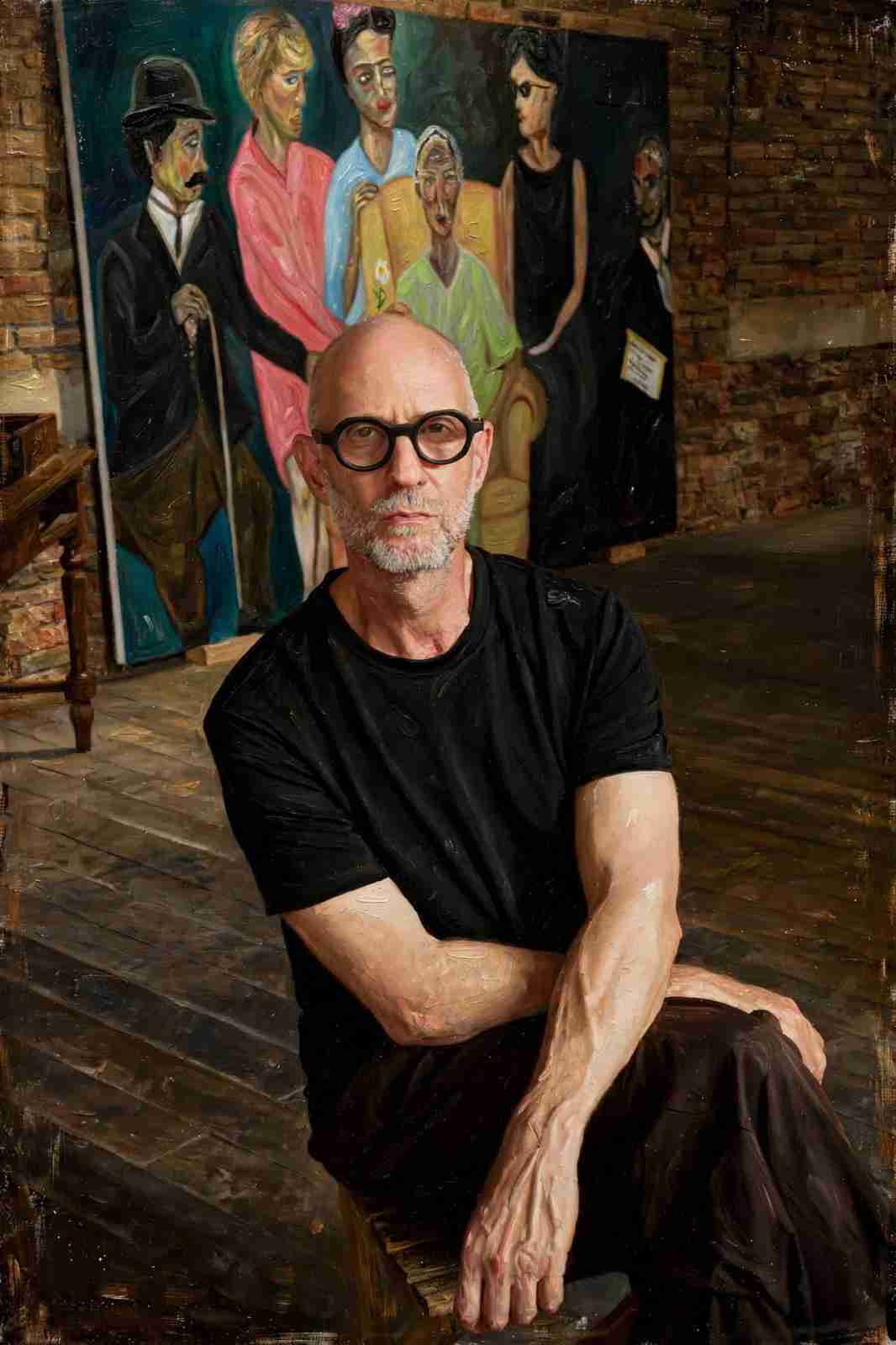
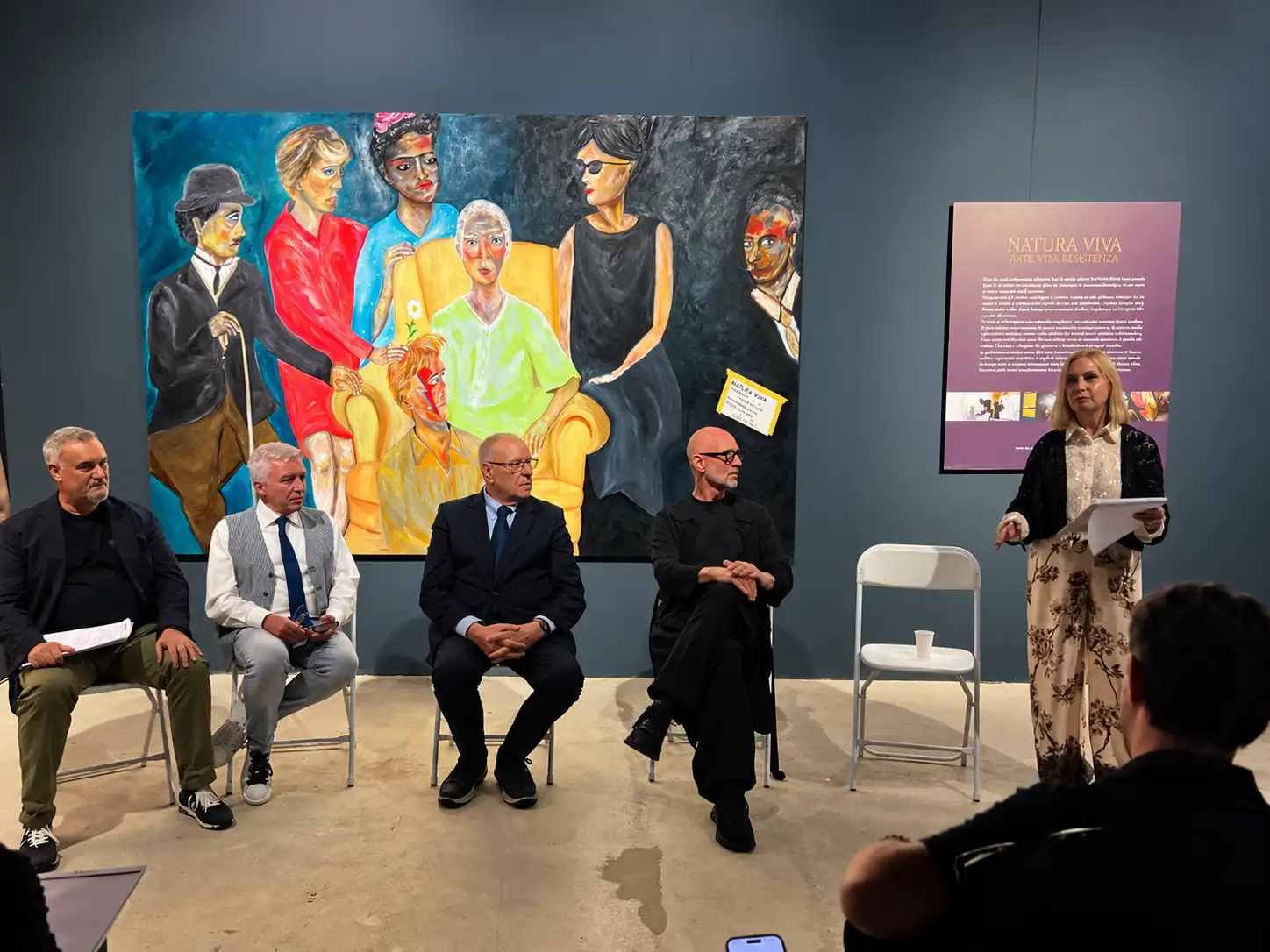
Presented in Venice on 7 September, in the spaces of the National Pavilion of the United Republic of Tanzania at the Gervasuti Foundation at Supernova, Angelo Orazio Pregoni’s NATURA VIVA – Il malato e il “secolo breve” places an ill person at the centre, surrounded by a system of gazes. This is where the painting becomes harder to dismiss: everyone is looking at that person, but that person is also looking out of the canvas.
I had already written about NATURA VIVA. Then I went back and stood in front of it again. What stayed with me was not the presence of the celebrities, the play of references, or the almost theatrical construction of the scene. It was the way everyone looks at the figure in the centre.
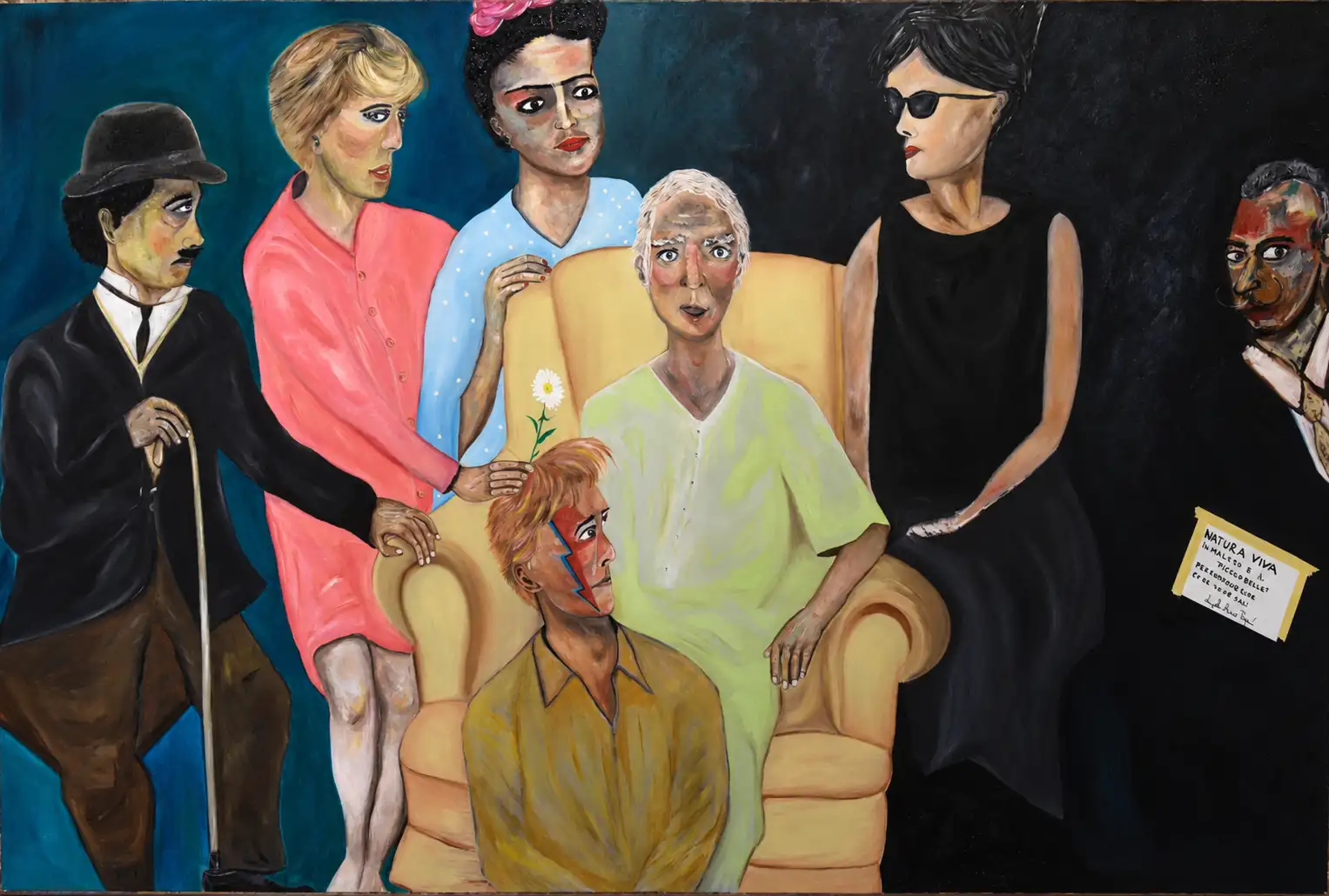
The pale yellow armchair has a double orientation: viewed from the right, it seems to point to the right; viewed from the left, it appears to turn the other way. Around it are Chaplin, Diana, Frida Kahlo, Audrey Hepburn, David Bowie, Dalí. They reach us before their names do: faces already familiar, already consumed by their transformation into images.
The person in the center follows a different logic. We do not know whether they are a man or a woman. We know nothing of their story, where they come from, or what they did before this scene.
We know only that they are ill.
And paradoxically, that one piece of information threatens to take up all the space.
A Person at the Centre
At the Venice press conference, much was said about the need not to reduce a person to a diagnosis. That is unavoidable when discussing medicine, care, research and quality of life. In front of the painting, though, the question leaves the careful language of public statements and becomes something visible.
The person in the armchair is looked at from different positions. A doctor sees symptoms, test results, examinations, response to treatment. Someone close to them watches the face, a gesture, perhaps the smallest change that everyone else misses. Those involved in care see practical needs. Research looks at possibilities, effectiveness, prospects.
Then there is my own gaze.
The first time, I had looked at the unfinished hand, the painted slip of paper on the right, the small white flower, the section of the composition that begins to lose itself in the black. I had searched for references, recognised the figures, studied the balance of the scene. That is what I do. I am a critic, and in front of an artwork I inevitably look for a position from which to read it.
But that position also creates distance.
The doctor has to remain a doctor, the family member remains a family member, and the critic cannot pretend not to have a profession of his own. The problem begins when these roles also become a way of marking out what belongs to the other person. The illness is theirs. The fear is theirs. The changing body is theirs.
As long as every gaze converges on the central figure, the painting seems to respect that division. Then there are the eyes.
The person looks out of the canvas. From that point on, the scene remains formally unchanged, but the relationship does not. I cannot claim to know what the person sitting there feels. That would simply be another form of appropriation. What I can recognize is that a condition which, a moment earlier, seemed confined to the other side of the painting has begun to affect my own position too.
And this is where a word enters the picture, one we are rightly careful with when talking about illness: death.
Diagnosis and death are not the same thing. Medicine works every day precisely to increase the distance between them. A painting, however, can enter a territory that the language of care has good reason not to turn into a verdict.
In NATURA VIVA, death is not announced. It stays in the background. But it would be artificial to pretend it is not there.
Holbein, Up to a Point
The mind almost inevitably goes to Hans Holbein the Younger’s The Ambassadors. The comparison is useful mainly because of where the two paintings part company. In Holbein’s painting there is a precise device: the anamorphic skull becomes legible only when you change position. The viewer has to physically move before death, present from the beginning, becomes visible. Pregoni constructs no such perspectival puzzle. There is nothing to decode by leaning sideways in front of the canvas. And yet the viewer’s position changes here too, only through the relationship with the figure.
As long as we look at the ill person from the outside, as doctors, relatives, critics or simply visitors, we can continue to think of fragility as something that belongs mainly to them. Once that gaze reaches us, the division becomes less stable. In Holbein there is a skull the first glance cannot see. Here there is a living person who makes it harder to treat death as a problem that belongs exclusively to someone else.
That interests me more than the generic reference to memento mori. We already know we are going to die. What we are remarkably good at is living as if that knowledge had very little urgency, at least until it takes on somebody else’s body. That is when the title starts to feel less straightforward than it first seemed.
A Living Still Life
NATURA VIVA is explicit enough as a title to immediately call up its opposite: natura morta, still life.
In the traditional still life, objects are isolated, arranged, held still. They often already contain the signs of their own decline: fruit that will ripen and rot, cut flowers, dead animals, candles, glasses, surfaces on which time leaves a mark. Pregoni instead places a living person at the centre of a scene that constantly risks immobilising them through definition. The ill person. The patient. The case. The diagnosis. Perhaps this is where some of the painting’s details become more interesting.
The unfinished hand never quite closes the figure. The black advancing from the right offers no neat conclusion. Dalí’s figure gradually loses definition towards the edge. The small slip appears to be a piece of paper attached to the surface, but it is paint, an illusion of order held inside the larger instability of the picture. The small white flower is there too, though it would be too easy to load it immediately with some consoling meaning.
The painting does not need these details to become fixed symbols.
It is enough to look at the difference between the person at the centre and the celebrities around them. Chaplin, Diana, Frida Kahlo, Bowie, Dalí are dead, yet their identities are remarkably solid. A single detail is enough for us to recognise them. They have names, histories, public images that continue to survive. The living person is the one who risks losing their name. They can become simply “the patient”. That may be the cruelest thing in the painting, and there is not much more that needs to be said.
A Work That Resembles Him
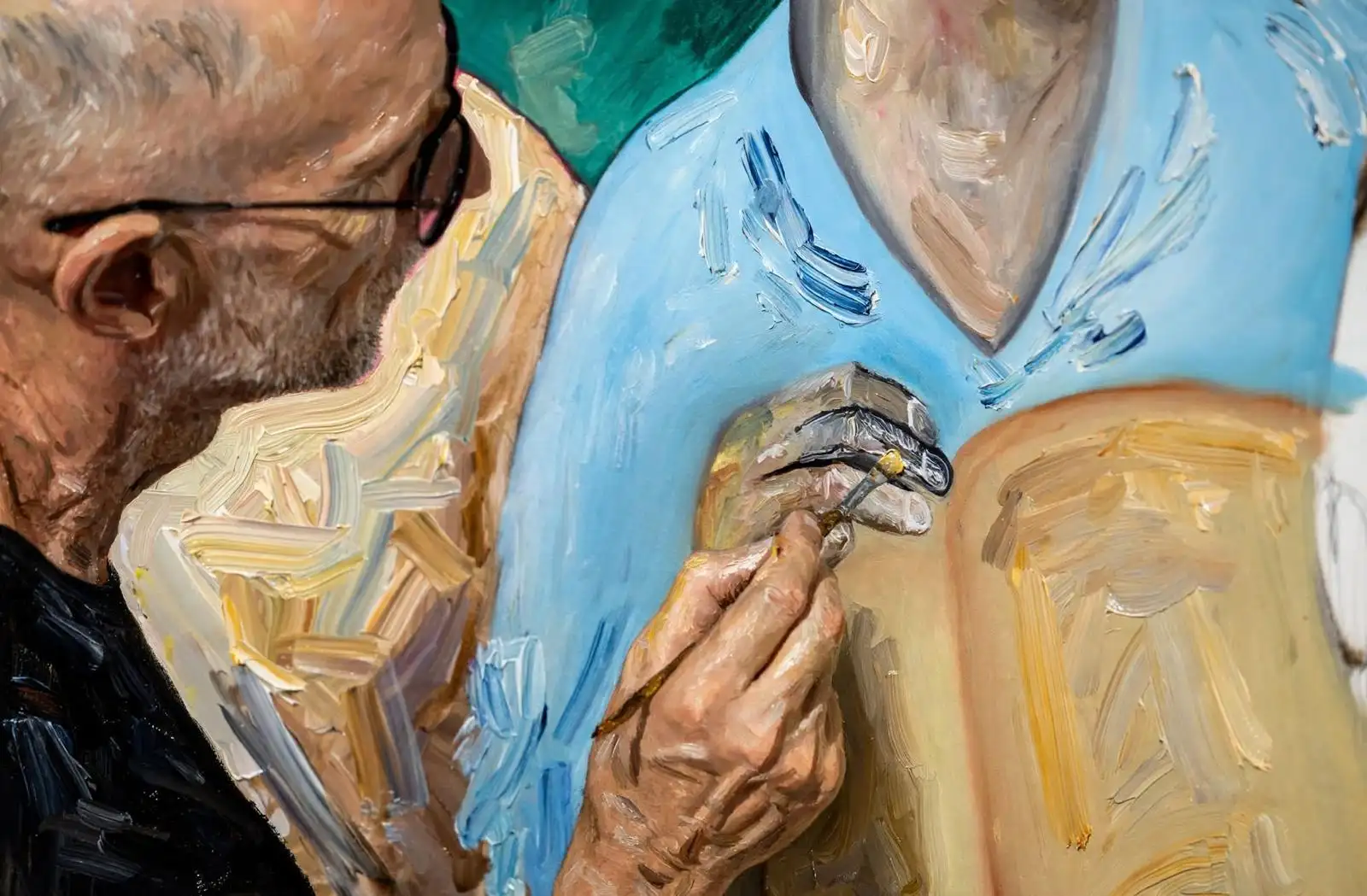
There is also something in the painting that I recognise in Pregoni himself. An artist’s character does not automatically explain what he paints, nor does it make the work better. But from what little I know of him, NATURA VIVA does resemble him.
Pregoni can be direct, cynical, destabilising. He does not seem especially interested in making what he considers real more comfortable. Yet I also see something romantic in this painting, provided the word is stripped of anything sweet. A romanticism without protection. Illness does not become an uplifting story and the fear remains exactly where it is. Pregoni insists instead on the presence of someone beneath the diagnosis, on a face, a body and, above all, a gaze that resists the category through which everyone else is looking at them.
During the press conference I called NATURA VIVA a memorable work. I still think so, but today I would phrase it differently. No work becomes memorable by decree.
NATURA VIVA can also be passed over quickly. There are plenty of escape routes: the celebrities, the references, the technique, the medical subject, Holbein, the Venetian context. I can talk about all of these things and still maintain a certain distance from the person in the armchair.
You have to remain in front of the painting long enough for the eyes of the central figure to stop being just another detail in the composition. At that point, I am no longer simply looking at an ill person. I am looking at a living person who is also looking at me. And death, which until then I had tried to leave politely on their side of the canvas, no longer stays there quite so easily.
From Antonino La Vela
I Saw It All. I Remember Almost None of the Art.: Notes from the Venice Biennale
Author: Antonino La Vela
Preface: Angelo Orazio Pregoni
A book of notes, encounters, fragments and memories from the Venice Biennale, looking beyond the official narratives to what remains after the exhibitions, the people and the works begin to disappear from memory.


