The Forma 1 Group – How political conditions destroied the Italian Abstractism
Bridging Contemporary Sociopolitical Art and Conceptual Modern Paintings to Marxism in Post-War Italy The story of Forma 1 still feels
Read More
Antonio Sanfilippo was an Italian painter and one of the leading figures of post-war abstraction in Italy. Born in Partanna, Sicily, in 1923, he developed a distinctive visual language based on signs, rhythm, movement, and colour, contributing significantly to the renewal of Italian painting after the Second World War.
In 1947, Sanfilippo was among the founders of Forma 1, together with Carla Accardi, Ugo Attardi, Pietro Consagra, Piero Dorazio, Mino Guerrini, Achille Perilli, and Giulio Turcato. The group rejected the opposition between political commitment and abstraction, declaring its members both formalists and Marxists and defending the autonomy of abstract artistic language.
Sanfilippo’s early work showed the influence of Neocubism and post-Cubist experimentation. His encounters with European avant-garde art, particularly during his travels to Paris, progressively encouraged him to move away from figurative structures and toward a more autonomous organisation of signs across the pictorial surface.
During the 1950s, his compositions became increasingly based on repeated marks, fragments, lines, and small chromatic elements distributed across open fields. Rather than constructing a central image, Sanfilippo created surfaces activated by countless signs that appear to expand, vibrate, and move through space.
This research placed him in dialogue with Art Informel, lyrical abstraction, and European gestural painting, while retaining a highly individual character. Unlike more violent forms of gestural abstraction, Sanfilippo’s marks often appear light, suspended, and rhythmically organised, producing a sense of continuous movement without abandoning compositional control.
From the early 1960s, colour became increasingly important in his work. Bright chromatic accents intensified the energy of his sign-based structures, transforming the canvas into a dynamic field in which individual marks interact without forming conventional figures or stable hierarchies.
Sanfilippo exhibited internationally and participated several times in the Venice Biennale. In 1966, he was given an important solo room at the Biennale, consolidating his position among the principal representatives of Italian abstraction. His work also entered into dialogue with artists and critics associated with the international development of non-objective and Informal art.
Within Italian contemporary art, Antonio Sanfilippo represents an important link between Forma 1, post-war abstraction, Informal painting, and the development of an autonomous language of signs. His work transformed the painted surface into an open field of rhythm, colour, movement, and visual energy.
 Forma 1 Group
Bridging Contemporary Sociopolitical Art and Conceptual Modern Paintings to Marxism in Post-War Italy The story of Forma 1 still feels
Read More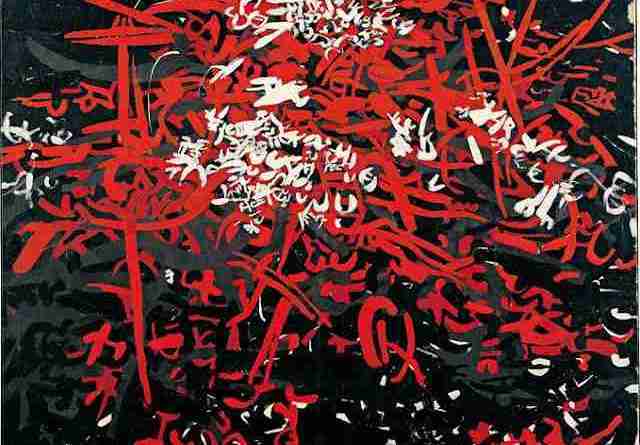 Antonio Sanfilippo – Black and Red (Abstract Screen 28/55)
Exploring the Legacy of a Master of Abstraction In the vivid tapestry of post-war Italian art, Antonio Sanfilippo stands out
Read More