

Artissima 2026: Who Gets to Become Visible, and What Happens After?
Artissima is often described as Italy’s most experimental contemporary art fair. But experimentation is only part of the story. Walking through the 2026 edition in Turin, a more interesting question emerges: who is given the possibility of becoming visible here, who decides, and what happens to an artist once that visibility has been produced?
There is always a strange moment at an art fair before you really begin looking at the art. You enter, recognize people, orient yourself inside the space, notice which booths are crowded and which remain mysteriously empty. Someone is already carrying a red-dot conversation. Someone else is photographing a work they probably will never think about again. Curators move differently from collectors. Journalists move differently from both. By the time you actually stand in front of an artwork, an entire system of attention is already operating around it.
At Artissima 2026, this becomes difficult to ignore.
The 33rd edition brings 183 galleries from 35 countries to the Oval Lingotto in Turin, with 67 monographic projects distributed across the fair. Those numbers describe its scale, but not what makes Artissima interesting. The fair has never built its identity by becoming the loudest, richest or most spectacular European marketplace. I wrote about this earlier in Artissima 2026 Is Not Basel. That May Be Its Strength. Seeing the fair fully assembled makes that distinction even clearer.
Artissima works best when it behaves less like a shop window and more like a filtering device. It brings artists, galleries, collectors, curators and institutions into temporary proximity, then watches what acquires weight.

The fair is never just where art is sold
We continue to speak about art fairs as though their primary function were obvious: galleries bring artworks, collectors buy them, everyone goes home. Economically, of course, that remains essential. No serious discussion of a fair should pretend that commerce is an embarrassing activity happening somewhere behind the intellectual program.
But the market is only one of the things being produced inside the Oval.
Reputation is produced here too. So is institutional attention. A gallery that appears marginal on Thursday can leave Turin with a curator following one of its artists. A work can move from a booth into a museum collection. An artist can shift, almost imperceptibly, from being someone shown by a young gallery to someone whose practice has entered a wider professional conversation.
This is why the most useful question at Artissima is not simply “What is selling?” It is “What is being made consequential?”
The distinction matters. Visibility has become one of the art world’s cheapest currencies. Instagram can make an installation visible to hundreds of thousands of people within hours. An art fair can generate thousands of photographs before lunch. None of that necessarily changes the position of an artist.
Consequence begins when looking produces another action: an acquisition, an invitation, a museum relationship, a critical argument, another exhibition, another encounter.
Fancy sounds innocent. It is not
The title chosen for the 2026 edition is Fancy: A Flexible, Acrobatic Body. It develops from Martha C. Nussbaum’s reflections on imagination as an ability to move beyond one’s immediate position and toward possibilities that do not yet exist.
At first sight, “fancy” is almost dangerously compatible with an art fair. Imagination, possibility, flexibility, openness: contemporary art has become exceptionally good at speaking this vocabulary. Put the right words around almost any exhibition and everything begins to sound transformative.
The problem is whether the structure underneath those words actually changes.
When I spoke with Artissima director Luigi Fassi earlier this year, he argued that fairs need to become cultural institutions rather than remain purely commercial platforms. It is an ambitious claim precisely because it creates a responsibility. Once a fair describes itself as producing culture, imagination and public value, sales figures can no longer be the only measure of its success.
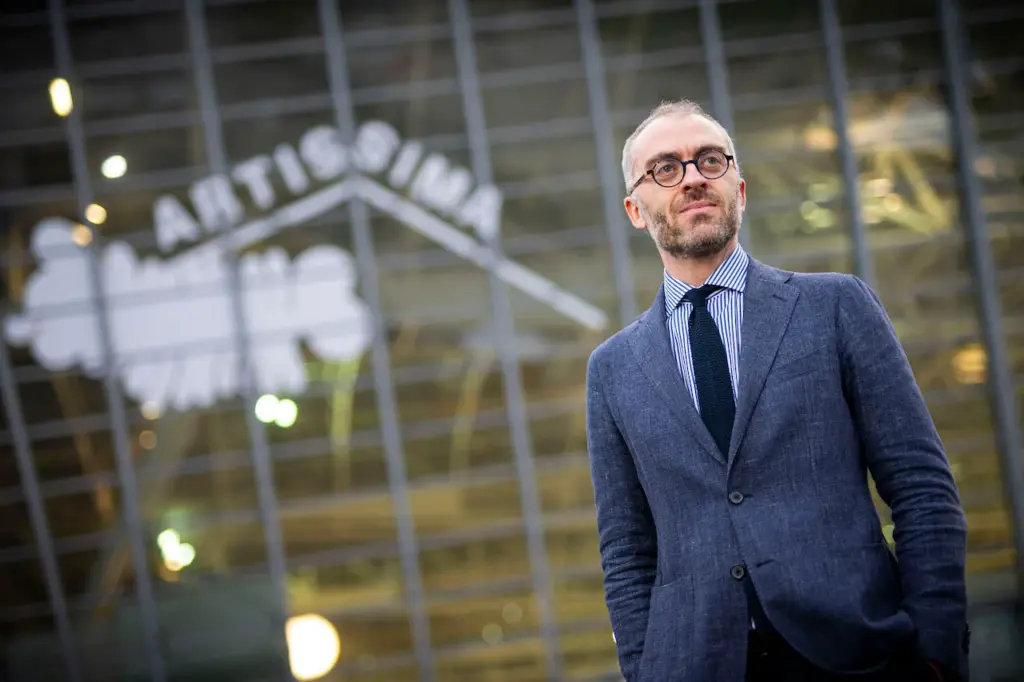
At the Oval, the interesting thing is that this contradiction is not entirely resolved. Nor should it be.
Artissima remains a market in which galleries have paid to participate and need to sell. At the same time, it has constructed a curatorial infrastructure that repeatedly interferes with the simple logic of supplying recognizable products to recognizable buyers.
Where Artissima becomes genuinely curatorial
The distinction is most visible in the three curated sections: Present Future, Back to the Future and Disegni.
Present Future, curated in 2026 by Léon Kruijswijk and Joel Valabrega, concentrates on emerging practices through monographic presentations. Back to the Future, curated by Jacopo Crivelli Visconti and Heike Munder, looks in the opposite chronological direction, recovering artists whose historical position deserves to be reconsidered. Disegni, curated by Irina Zucca Alessandrelli, isolates drawing from its usual subordinate status and treats it as an autonomous field of research.
Placed together, the three sections quietly undermine the linear idea of artistic success.
An emerging artist is presented beside an artist who may have worked decades ago without receiving sufficient attention. A drawing can demand as much concentration as an installation. Recognition appears neither inevitable nor chronological. The supposedly “new” coexists with practices that were once new but were not adequately seen when they emerged.
This temporal instability is one of Artissima’s strongest qualities.
Art history likes to appear orderly after the fact. Careers acquire beginnings, breakthroughs, movements and periods. Fairs expose something messier: the moment before history has decided what will matter.

Who makes the decision?
There is another reason Artissima interests me more as a critical object than as a simple marketplace. Selection is unusually visible here.
The four principal sections, Main Section, Monologue/Dialogue, New Entries and Art Editions, are selected by a committee of international gallerists. The curated sections operate through curators and museum professionals. Then come collectors, directors, critics, foundations and prize juries, each applying another filter.
No single person decides who matters. The system works through accumulation.
A gallery chooses an artist. The fair chooses a gallery. A curator chooses a project. A collector buys. A critic writes. A museum acquires. Another museum notices the acquisition. Eventually what looked like a sequence of individual judgments begins to resemble cultural legitimacy.
This does not make the process corrupt or illegitimate. It makes it worth examining.
One of the persistent myths surrounding contemporary art is that quality eventually reveals itself, as though artworks possessed some internal signal that institutions merely had to detect. Artissima demonstrates something more complicated. Quality matters, but so do access, geography, timing, relationships, economic survival and the ability of a gallery to keep an artist visible long enough for someone else to pay attention.
The €300,000 question
The institutional dimension becomes concrete through Artissima’s acquisition system.
For 2026, Fondazione Arte CRT has confirmed a €300,000 acquisition fund for works destined for the collections of GAM – Galleria Civica d’Arte Moderna e Contemporanea di Torino and Castello di Rivoli Museo d’Arte Contemporanea. The fair also hosts a substantial network of prizes and funds decided by international juries.
This is where the border between market and institution becomes particularly productive.
A work sold to a private collector has entered a collection. A work acquired for a museum has entered something else: a structure of preservation, exhibition, research and historical narration. The economic transaction may take only minutes; the institutional consequence can last decades.
That is much more interesting than the usual opposition between “commercial” and “curatorial” art.
The two systems are already entangled.

Why the less obvious galleries matter
Walking through Artissima, I find myself spending less time looking for famous names than watching where the visual temperature changes.
Large fairs can become exercises in recognition. You see the artist you already know, represented by the gallery you already know, surrounded by people reassuring one another that they know both. The work almost arrives pre-interpreted.
Artissima is more useful when recognition fails.
Its internationalism matters not simply because 35 countries look good in a press release, but because galleries from less dominant art centers can occupy the same temporary geography as established European players. The hierarchy does not disappear, but for several days it becomes permeable.
This is particularly important now. The contemporary art system speaks endlessly about globalization while economic power remains concentrated in a relatively small number of cities, galleries, institutions and collectors. A fair cannot correct that imbalance. It can, however, create interruptions in it.
New Entries is important for precisely this reason. The section is reserved for young international galleries active for fewer than five years and appearing at Artissima for the first time. Its value is not simply that these galleries are young. Youth itself is not a curatorial criterion. What matters is that the fair allocates expensive attention to structures that have not yet accumulated much of it.
Turin changes the fair
Artissima also benefits from something it does not entirely control: Turin.
During Art Week, the fair sits inside a much larger institutional and historical ecology. Castello di Rivoli, GAM, Fondazione Merz, Pinacoteca Agnelli, Fondazione Sandretto Re Rebaudengo, OGR Torino, private foundations, galleries and independent spaces create a network in which the commercial event never completely isolates itself from museums and exhibitions.
I explored that larger constellation in Turin Art Week 2026: The Fairs, Exhibitions and Events Worth Seeing. Experiencing the week makes one thing obvious: Artissima may be its center of gravity, but the city prevents the fair from becoming the whole story.
That matters because, outside the Oval, different forms of artistic time are operating simultaneously. Marisa Merz and Carol Rama are being reconsidered through major institutional exhibitions while emerging artists are trying to establish positions inside the fair only a few kilometers away. History and speculation coexist.
Some artists are waiting to be discovered. Others are still being rediscovered decades after they should have been impossible to ignore.
What remains when the booths disappear?
On Sunday evening, Artissima will begin dismantling itself.
That physical disappearance is one of the reasons fairs fascinate me. For several days they seem enormous, almost unavoidable. Then the walls come down, the lights are switched off and hundreds of artworks return to crates, galleries, studios, collections and museums.
The architecture disappears faster than the value it has produced.
Some works will have been sold. Others will have entered institutional conversations. A few artists will have acquired a new curator, collector or museum contact. Many will leave with nothing immediately measurable. Months later, however, an encounter that seemed irrelevant inside the Oval may suddenly produce an exhibition or acquisition.
This is why judging an art fair exclusively through attendance and sales eventually becomes inadequate.
Artissima is most persuasive not when it tries to prove that it is different from the market, but when it makes visible how the market, curatorial research and institutional power are already shaping one another.
Its real subject may not be contemporary art at all.
It may be the process by which contemporary art acquires a future.
Artissima 2026
Where: Oval Lingotto Fiere, Turin
Public dates: October 30 to November 1, 2026
Preview: October 29, 2026
Director: Luigi Fassi
Galleries: 183 from 35 countries
Official website: artissima.art


