
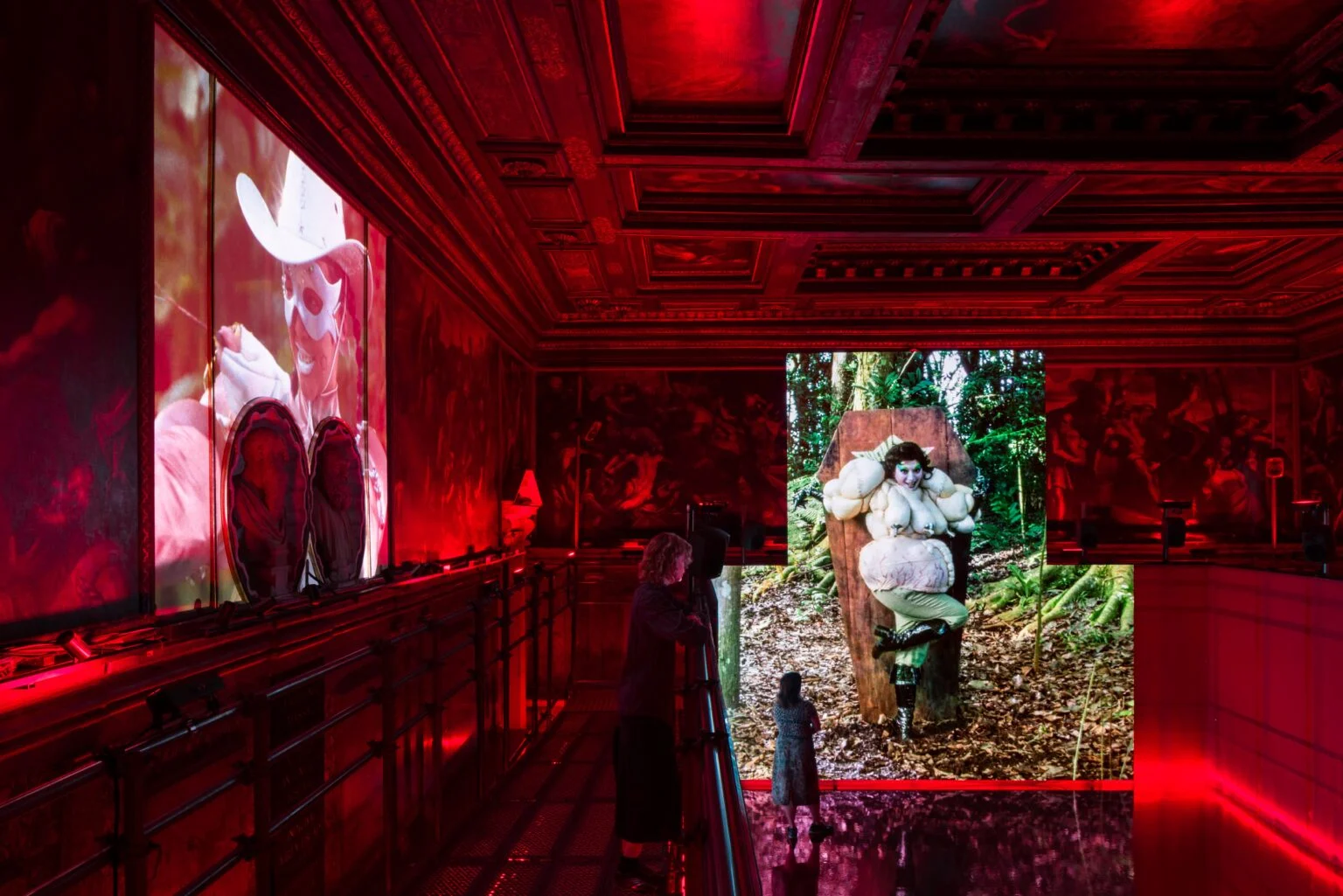
From Historic Palace to Battlefield for Ghosts: An Interview with Natasha Tontey in Venice
Until 25 October 2026, ancient rituals, surveillance technologies and colonial memories run through Indonesian artist Natasha Tontey’s installation at the Ateneo Veneto. We asked her to tell us about her work.
Originally published in Italian on Artribune on 6 September 2026.
The first sensation on entering Natasha Tontey’s (Minahasa, 1989) installation is not that of looking at an artwork, but rather of being pulled inside an altered organism. The seventeenth-century ceilings of the Ateneo Veneto are immersed in red. Unstable anatomies seem to emerge simultaneously from a shamanic ritual and a dystopian B-movie.
Surveillance technologies, Indigenous mythologies and Cold War memories overlap until they become indistinguishable. With The Phantom Combatants and the Metabolism of Disobedient Organs, commissioned by LAS Art Foundation and Amos Rex during Biennale Arte 2026, the Indonesian artist has created one of the most disturbing and layered installations currently visible in Venice.
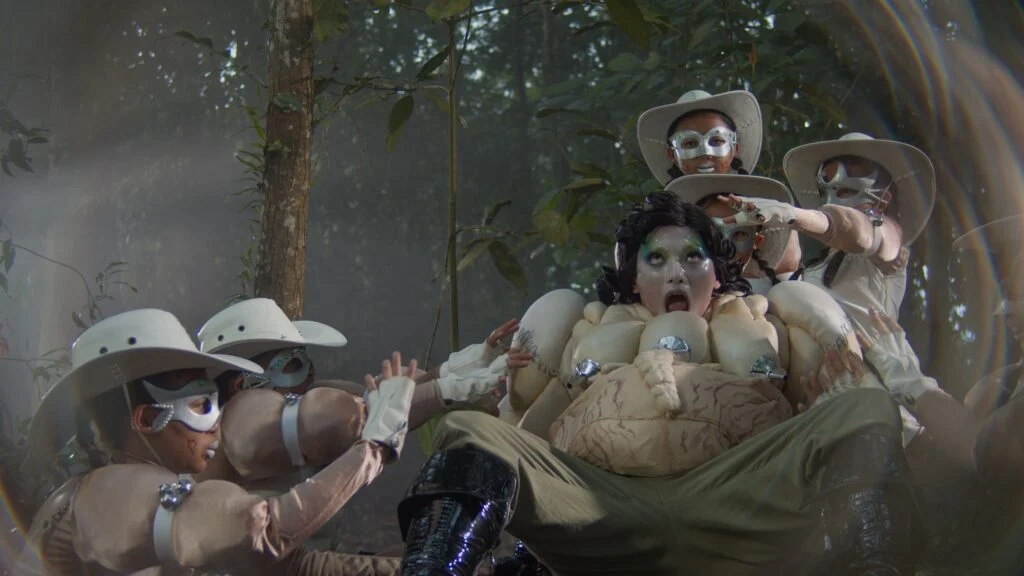
Natasha Tontey Between Cold War, Rituals and Surveillance
The project begins with the figure of Len Karamoy, a combatant of the Permesta movement active in North Sulawesi between 1957 and 1961 against the centralized Indonesian government, within a conflict marked by American involvement and Cold War tensions. Yet Tontey never attempts a linear historical reconstruction. In her work, history behaves more like a contamination than an archive. Identities multiply. Bodies lose stability.
Ritual collides with synthetic imagery. Indigenous spirituality merges with military imaging and surveillance technologies. What emerges is not simply a political narrative about Indonesia. Rather, it becomes an uneasy reflection on how systems of power continue to shape bodies, images and even what a society decides to consider real.
Natasha Tontey’s Arrival in Venice
With The Phantom Combatants, Natasha Tontey has created one of the most radical works within the constellation of exhibitions unfolding across Venice in 2026. Not because it simply speaks about colonialism or identity, but because it transforms those themes into an unstable organism, difficult to domesticate.
Inside her installation, history never appears concluded. Instead, it continues to mutate through new bodies, new images and new systems of power. As if the ghosts of the Cold War had never truly disappeared, but had simply changed aesthetics.
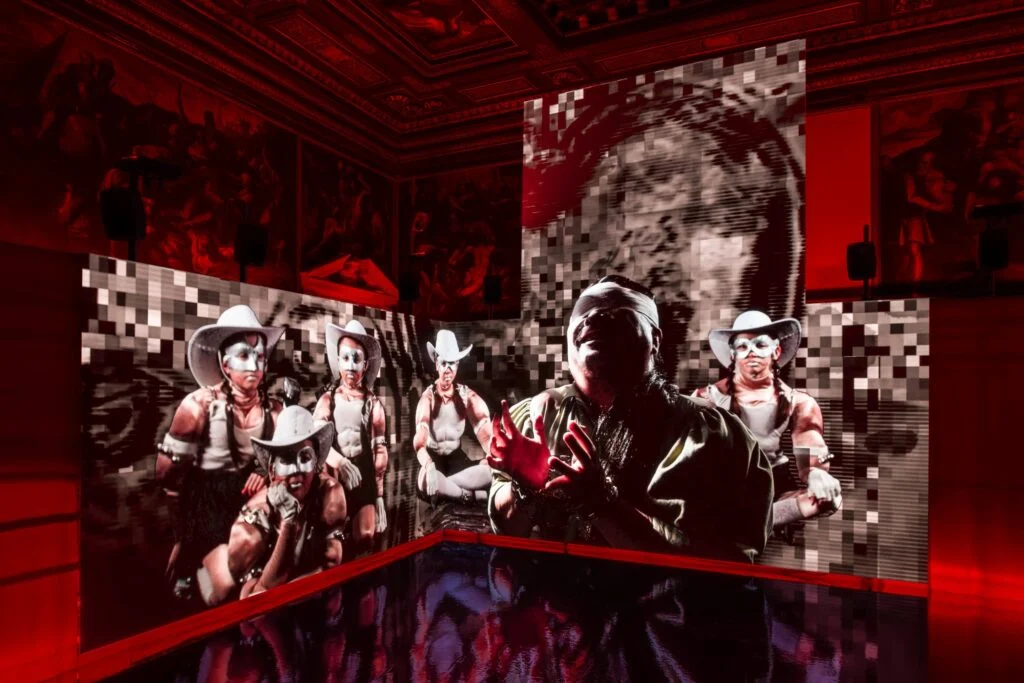
Interview with Natasha Tontey
The bodies in your work are excessive, hybrid, almost monstrous. Are they liberated bodies, or bodies that reveal how power continues to inscribe itself into flesh?
For me, the body is never innocent. It is already full of systems. Religion, propaganda, desire, violence, colonialism. Everything enters the body. Many people look at these anatomies and see something grotesque or fantastical. But to me they are realistic bodies. Bodies that have absorbed too many structures at once.
In Indonesia there are still many political ghosts. The difference is that today they no longer appear as historical figures. They enter media, advertising, fitness aesthetics, models of masculinity, even ideas of efficiency. I’m interested in the moment when the body stops functioning properly as a stable identity. When it becomes almost like a corrupted interface.
In the project, Len Karamoy ceases to be merely a historical figure and becomes a collective, almost mythological presence. What happens when history enters fiction?
For me, fiction is not the opposite of truth. Sometimes it is the opposite: it is the place where truth survives longer. Many official archives in Indonesia were built through erasures, especially during and after the Cold War. Some stories continue to exist only in incomplete forms: voices, rituals, family stories, superstitions.
Len Karamoy kept appearing during my research in that way. Not as a fully documentable figure, but as something that continuously returned. I’m interested in these unstable presences. Almost narrative organisms. Maybe ghosts are also political technologies.
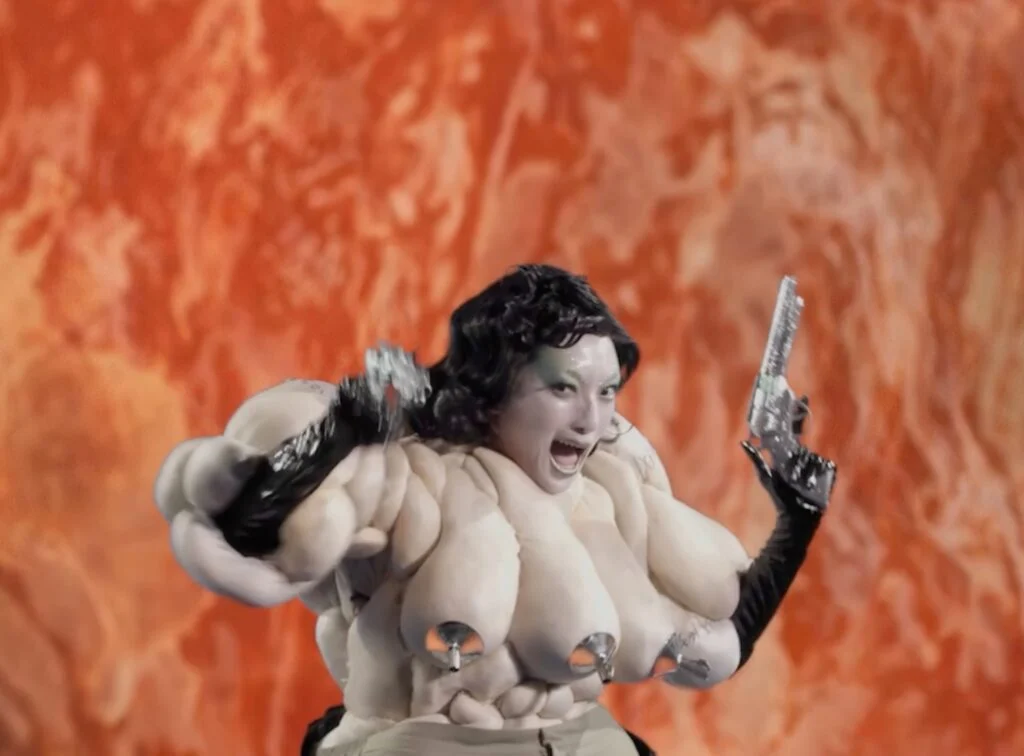
Natasha Tontey Between Indonesian Tradition and a Global Outlook
Your work constantly addresses the relationship between colonialism, American intervention and the construction of Indonesian identity. Are you trying to recover narratives left outside Western perspectives?
Yes, but I don’t think the problem is only the West. National narratives can also become very aggressive systems. Permesta has often been narrated only through the geopolitics of the CIA and the Cold War. But when you speak with local communities, other dimensions emerge: spiritual, territorial, bodily.
I come from Minahasa culture, which is already a highly hybrid territory: animism, Christianity, Dutch and Japanese colonialism, early contact with the Portuguese and Spanish, modern militarization, and authoritarian regime. Everything coexists. Many people search for pure identities. I’m more interested in contaminated identities.
In your work, ritual, technology and military imagery constantly coexist. Technology almost appears as a new spiritual system.
Because in part it already is. Contemporary technologies do not simply produce images. They produce shared realities. Even military imaging and surveillance tools function almost like spiritual machines. They produce invisibility and visibility. They decide what exists.
But I’m also interested in the possibility of hacking those systems. Many Indigenous forms of knowledge were considered primitive simply because they did not produce data according to Western standards. Yet they had other systems of perception. Maybe the problem is not technology itself. The problem is who decides what is considered real.
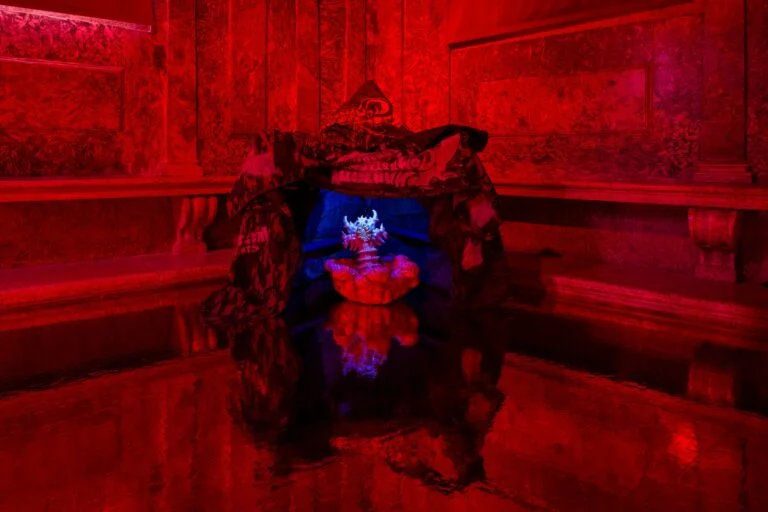
Natasha Tontey’s Work in Venice
Presenting this work inside the Ateneo Veneto creates a strong tension between Indigenous cosmologies and European historical architecture. Was that tension intentional?
Absolutely. For me, space is never neutral. The Ateneo Veneto carries centuries of European history tied to cultural, religious and academic authority. I wanted to insert these altered presences and rituals into that architectural system. Almost like a form of infiltration.
Even the Cycle of Purgatory ceiling creates something strange. At a certain point it becomes impossible to understand whether the bodies are emerging from the past or from the future. I like when artworks produce a sensation of unstable orientation. When perception stops being stable.
This Biennale is marked by geopolitical tensions, protests and discussions about global representation. Are you afraid your work might be read only through a political lens?
That risk always exists. But I also think the problem today is not the presence of politics in art. The problem is when politics becomes too easily consumable. Many contemporary artworks exhaust themselves too quickly within a position. I’m more interested in creating friction. I don’t want the audience to feel morally safe.
I’m interested in that more ambiguous sensation, when something appears seductive and disturbing at the same time. When it becomes unclear whether one is looking at a ritual, a video game, a historical archive or a collective hallucination. Maybe that is where complexity can still survive.
Antonino La Vela
Venice // until 25 October 2026
Natasha Tontey. The Phantom Combatants
ATENEO VENETO DI SCIENZE, LETTERE ED ARTI – Campo San Fantin, 1897


