
Angelo Orazio Pregoni Finishes NATURA VIVA at the Venice Biennale. What Does a Finished Image Leave Out?
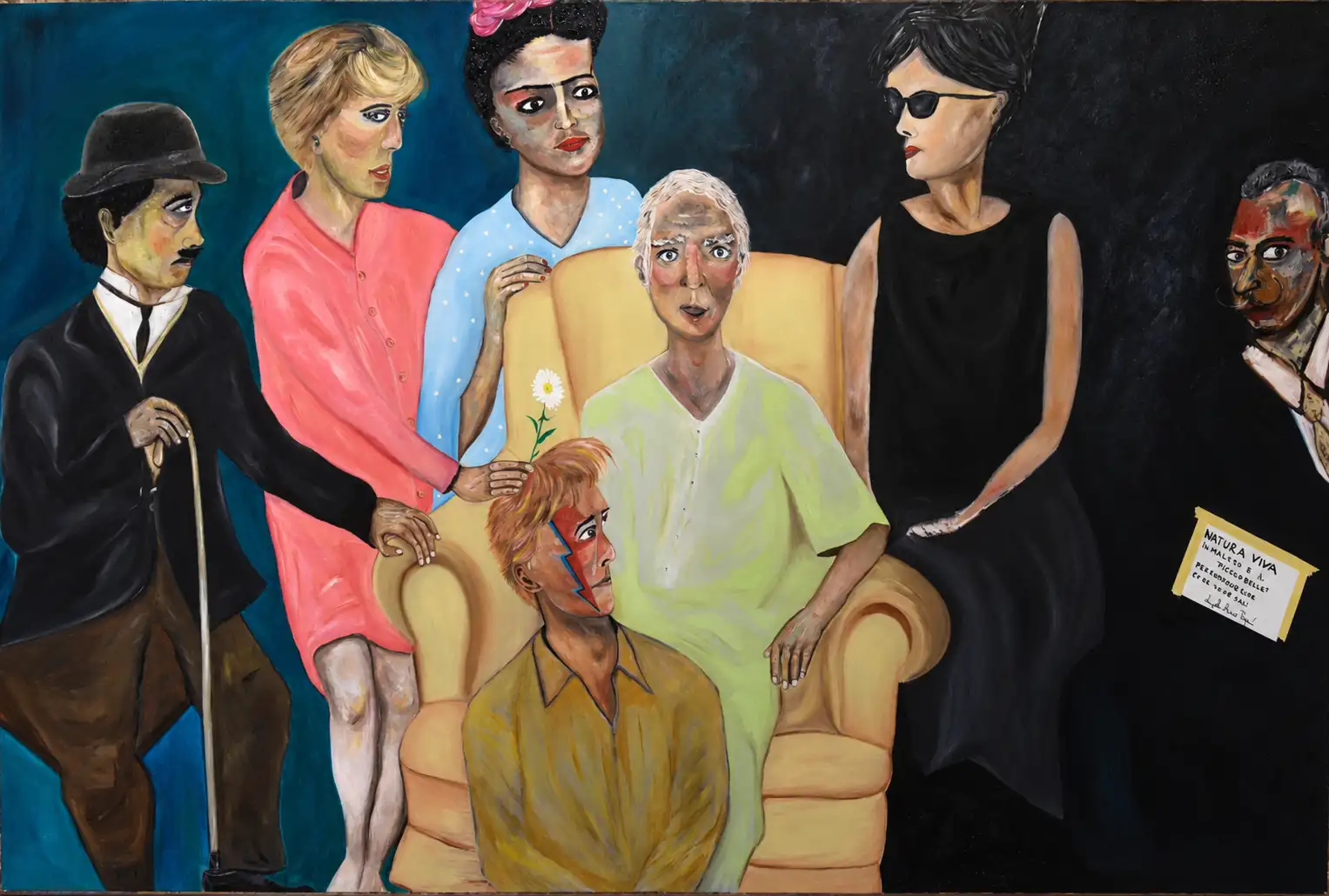
Angelo Orazio Pregoni’s completed monumental painting NATURA VIVA, developed through a live painting performance at the Tanzania Pavilion during the 61st Venice Biennale.
The Painting Has Stopped, but Not Everything Inside It Has
Angelo Orazio Pregoni has completed NATURA VIVA – Il malato e il “secolo breve” after the live painting action that began on 27 August at the National Pavilion of the United Republic of Tanzania during the 61st Venice Biennale. The three-by-two-metre canvas has now reached the point at which an artwork is supposed to stop changing. It has a composition, a title, a date and a signature. Yet, looking at it now, what interests me is less the fact that Pregoni has finished than the slightly awkward way in which the painting announces that it is finished.
On the right, against the black surface, there is what appears to be a small white sheet fixed with yellow masking tape. The title, date and signature are written on it. At first it looks almost incidental, the sort of temporary note one might expect to disappear once the studio work is over. But there is no paper and there is no tape. Pregoni has painted both. The trompe-l’oeil is technically convincing, although the technique is not really the point. What looks like the document confirming the end of the painting is itself part of the painting.
It brings me back to the question I raised when I wrote about NATURA VIVA before the performance began. Live painting is not automatically performance. It can just as easily become theatre around the old spectacle of the artist at work: the audience watches, effort becomes visible, photographs accumulate, and none of this necessarily changes the object produced at the end. What mattered was whether those days in Venice would somehow remain on the canvas once the event was over. Looking at the finished work, they do, although not in the heroic way that descriptions of artistic endurance sometimes suggest.

The man in the chair
The completed composition is organised around an elderly patient sitting in a large pale-yellow armchair. Charlie Chaplin enters from the left. Around the chair appear Diana, Princess of Wales, Frida Kahlo, Audrey Hepburn and David Bowie, while Salvador Dalí is already losing definition on the darker side of the canvas. Seen together, they resemble an impossible group photograph, with people belonging to different decades and different kinds of mythology brought into the same room.
What initially looks almost ceremonial becomes stranger the longer one looks at it. The chair is large enough to give the patient the position of a patriarch or even a monarch, but nothing about him suggests authority. Quite the opposite. He is surrounded, observed and physically enclosed by the composition. Illness often creates this peculiar situation: a person becomes the centre of appointments, family discussions, medical decisions and anxieties while simultaneously losing some control over the most basic organisation of his own life.
The figures around him can certainly be read as protective, but I would not make that reading too comfortable. Their presence also compresses the space around the patient. Hands approach, bodies accumulate and there is almost no empty air left around the chair. Care can protect, but it can also mean dependence, exposure and the surrender of privacy. None of this makes care negative. It simply makes it less sentimental.
There is another imbalance that interests me more than the list of celebrities itself. Almost everybody around the chair comes with an identity already fixed in collective memory. Chaplin only needs his hat and cane. Bowie has the Aladdin Sane lightning bolt. Kahlo, Hepburn, Diana and Dalí have become images that culture recognises before it really looks at them. The man in the chair has none of this. He is simply the patient.
That is not a neutral description. Medicine inevitably translates people into symptoms, measurements, diagnoses and treatment protocols because otherwise it could not function. But there is always a point at which useful classification can begin to swallow biography. Everyone else in the painting has a name. The central man has a condition.
And yet he is the one who looks most directly at us. The celebrities occupy the canvas, but their attention is elsewhere. The anonymous man returns the gaze. It is a small compositional decision, but it changes the balance of the scene. The faces we already know become surprisingly easy to ignore; the person we cannot identify is more difficult to get past.
This recalls a question I explored with Cassils around the ethics of visibility and the responsibility of looking. The problem is rarely solved by making another body visible. We already see an enormous number of bodies every day. The question is what that visibility asks from us once recognition has happened.

A twentieth century made of familiar faces
The title invokes Eric Hobsbawm’s “short twentieth century”, the historical period extending from 1914 to 1991. Pregoni does not approach that century through governments, wars or political ideologies. He chooses faces. Hobsbawm’s historical construction remains useful because it gives the period boundaries while leaving open the much more difficult question of what continued after those boundaries. The Age of Extremes ends in 1991. History obviously did not.
Using Chaplin, Kahlo, Bowie, Hepburn, Diana and Dalí is nevertheless dangerous. Their recognisability can do too much of the work. Bowie is Bowie immediately; Chaplin hardly needs to be looked at twice. There is always the possibility that the twentieth century becomes nothing more than a particularly attractive guest list, with cultural memory reduced to a sequence of faces we are pleased to recognise.
Pregoni had already approached this problem in Ujamaa Express, where Van Gogh, Mozart and Maria Callas appeared alongside Tanzanian and Swahili figures. There the imbalance was between the images immediately available to a Western viewer and those requiring more knowledge. Pregoni spoke about Western icons worn down through repetition. Here he seems to turn the same problem inward.
The paint helps. These are not particularly flattering commemorative portraits. Skin slips towards green, grey and red, features stretch and sometimes appear tired rather than iconic. Dalí is the most obvious case. On the right he never quite becomes solid, as though the painting remembers his outline but is less certain what to do with him.
Perhaps this is where the “pathology” suggested around the work becomes interesting. Not because the twentieth century itself can be diagnosed, which would be an enormous and rather empty claim, but because our memory of it has become so efficient. Kahlo can be reduced to pain and identity, Bowie to reinvention, Chaplin to humanism, Dalí to Surrealism. We preserve the face and progressively compress everything difficult behind it.
What happens when an image stays visible for too long?
The painting also changes physically from left to right. Much of the left and centre is crowded and relatively bright, with turquoise, yellow, green and red keeping the figures available to the eye. Towards the right, black occupies more of the surface and the image becomes uncertain. Dalí seems to belong almost entirely to that other territory.
The most immediate symbolic opposition would be life and death, but I am not convinced by it. The transition feels less final than that. It resembles the movement from presence into memory, or perhaps the moment at which an image is still recognisable but has started to lose the complexity once attached to it.
We normally worry about images disappearing. I am increasingly interested in the opposite problem. Some images never disappear. We see war, illness, environmental catastrophe, political violence and vulnerable bodies continuously, and repetition can make them strangely easy to absorb. Visibility is not necessarily the opposite of forgetting. Sometimes it is one of the ways forgetting happens.
Kader Attia approached something adjacent when I interviewed him in Venice about repair, wounds and the persistence of traces. His idea of repair refuses the fantasy that something damaged can simply return to an untouched state. The scar remains because history remains. Pregoni is doing something different, but the unresolved passages of NATURA VIVA work best when they resist being cleaned into a completely stable final image.

An unfinished hand, a flower, a fake document
Pregoni has deliberately left one hand unfinished. It could easily be dismissed as one more remnant of the live process, but the choice happens to sit rather well with what he has said about the work: the conflict between action and thought, existence and impotence. The hand is the point at which intention usually becomes action. We grasp, write, touch, make, refuse and care through it. Leaving it unresolved gives impotence a physical detail without having to illustrate it theatrically.
Nearby, the small white flower could become an equally easy piece of symbolism. Hope is the obvious interpretation, especially once illness and medical research enter the story. I am less interested in making it carry that burden. The flower is small, fragile and still there. That seems enough. It does not need to defeat anything.
The white rectangle on the right is different. Its geometry interrupts everything around it. Bodies are irregular, paint shifts, faces are unstable, while the sheet has borders, information and apparent order. It looks almost bureaucratic. This is where the fact that it is painted becomes more interesting than the trompe-l’oeil itself.
Illness generates paperwork with astonishing speed: appointments, blood results, diagnoses, protocols, reports. Art produces its own documentation: artist, title, year, medium, dimensions, provenance, inventory. Obviously these are very different systems, but both have to translate something unstable into a form that can be recorded and communicated.
The translation is necessary. It is also incomplete. A diagnosis cannot contain a person any more than a catalogue entry contains a painting. Pregoni makes this almost literal because his little document, the thing that seems to fix title, date and authorship, is not actually there. It is another layer of representation.
This also gives the work a direct connection to Minor Frequencies: The Inner Life of a Nation, organised around Body, Gesture, Archive and Mind. Those terms could easily remain curatorial abstractions. Here they become unexpectedly concrete: a vulnerable body, days of painting as gesture, the false document as archive, and a group of cultural images moving between memory and disappearance. The interesting part is not that Pregoni can be fitted neatly into the four categories. It is that the painting keeps leaking out of them.
Was the live performance necessary?
Now that the painting is finished, the question can be asked less politely. Painting for eleven days in front of an audience does not by itself create performance art, and fatigue does not become a concept merely because spectators can see it. Live painting can be surprisingly conservative. It relocates the traditional image of the artist struggling with the canvas from the private studio to a public space and hopes that visibility changes its meaning.
There is no way of proving that every hour of Pregoni’s action was necessary. Some of it inevitably belonged to the event around the work: the presence of visitors, photographs, conversation, physical exhaustion. What matters now is that the canvas has not been polished so thoroughly that all this instability disappears. Dalí remains somewhere between apparition and sketch, the hand stays incomplete, surfaces have different levels of resolution, and the supposedly final label uses the visual language of something temporary.
I would not say that this automatically vindicates the performance. It does something more modest and probably more useful. It makes it difficult to imagine the final work as an object that simply appeared in its present state.
Illness cannot become the happy ending
The project has received support from BeOne Medicines Italy and developed partly through reflection on chronic lymphocytic leukaemia and the changes medical research has brought to its treatment. BeOne has an active programme in CLL, with several projects listed in its oncology development pipeline. That context is relevant, but it also brings with it a problem that the painting should not pretend does not exist.
Medical and pharmaceutical narratives understandably depend on measurable outcomes: response, disease control, survival, duration of treatment. Art works badly when it simply supplies the emotional image for those numbers, as though research, treatment and resilience naturally formed a complete story with an uplifting ending.
NATURA VIVA is more interesting where it refuses that role. Medical progress can change prognosis dramatically, but it does not measure everything that illness changes around a person. Time behaves differently. Relationships change. Dependency arrives where it did not exist before. Even when treatment returns the possibility of a future, it does not necessarily return the same relationship to that future.
This is also why the patient should not become proof of either tragedy or success. He remains sitting in the middle of the work, still looking towards us, surrounded by people whose images have long since acquired meanings of their own.
The painting has stopped
Pregoni has now done the one thing that finally makes a painting complete: he has stopped working on it. NATURA VIVA can be photographed in a definitive state, archived and reproduced without the expectation that tomorrow another figure will move or another section will disappear. The title, date and signature fix the object in time.
Other things in the painting are harder to fix. Hobsbawm could put dates around the short twentieth century, but its consequences did not stop in 1991. A medical file can eventually be closed while illness continues to affect memory, identity and relationships. A cultural image can remain visible for decades while becoming increasingly detached from whatever once made it difficult.
This, more than the rhetoric of resilience, is what I take from the completed work. We have many ways of declaring something finished: diagnoses, labels, historical periods, archives, final photographs. They are useful because without them almost nothing could be organised. But organisation and understanding are not the same thing.
Pregoni’s little white sheet looks as though it has come to settle the matter. Instead, once we discover that it is only paint, it leaves the matter slightly less settled than before.


