

Art Basel After the First Look
Art Basel 2026
From Timur Si-Qin to Pacita Abad, Nairy Baghramian, Ibrahim Mahama and Irma Blank, a day at Art Basel 2026 became less a search for trends than a test of which works could survive the exhaustion of looking.
In Basel, the works that mattered most to me were not always the ones that stopped me immediately. They were the ones that returned later, after the fair had exhausted the eye, the body, and the small social discipline required to keep looking.
I arrived in Basel with a ticket bought online, not with the protection of a preview ritual. No collector’s lunch, no private choreography, no soft landing. Just the road, an early coffee, the slightly ridiculous hope of seeing enough, and that familiar anxiety that comes before entering a place where one is supposed to understand quickly.
A system for organizing attention.
At first, I followed it. The aisles, the booths, the names, the discreet signals of importance. A crowd in front of a work. A gallerist standing rather than sitting. A collector speaking quietly. A painting given just enough wall to breathe. A sculpture placed so that it seems accidental, although nothing there is accidental.
For the first hour, I still believed in my own eye. After that, I began to distrust it.
Too much at Art Basel is made to work immediately. This is not a moral accusation. A fair is cruel to art because it gives almost everything too little time. A work has to introduce itself before the next work interrupts it. It has to hold its ground against scale, reputation, money, fatigue, photography, and the strange pressure of being seen among too many things already asking to be seen.
So, after a while, I stopped asking myself what impressed me.
I began asking what remained.
That difference changed the day. Many works impressed me and disappeared. They had the right surface, the right intelligence, the right historical weight, the right political temperature. They performed well in the first encounter. They knew how to be looked at. But some works, less obedient to the first glance, came back later. They returned while I was walking elsewhere, while checking the map, while looking for water, while answering a message, while trying to remember which hall I had already crossed.
Those were the works I trusted more.
Timur Si-Qin’s Mariposita stayed with me for that reason. I had interviewed him, and perhaps this gave the work a second door. Still, what held me was not the technology, nor the ecological language, nor the immersive ambition. What held me was the way the work refused to treat nature as a lost innocence. It did not ask for nostalgia. It did not ask for guilt in the usual, efficient way. It seemed to build a belief system after belief had already been damaged.
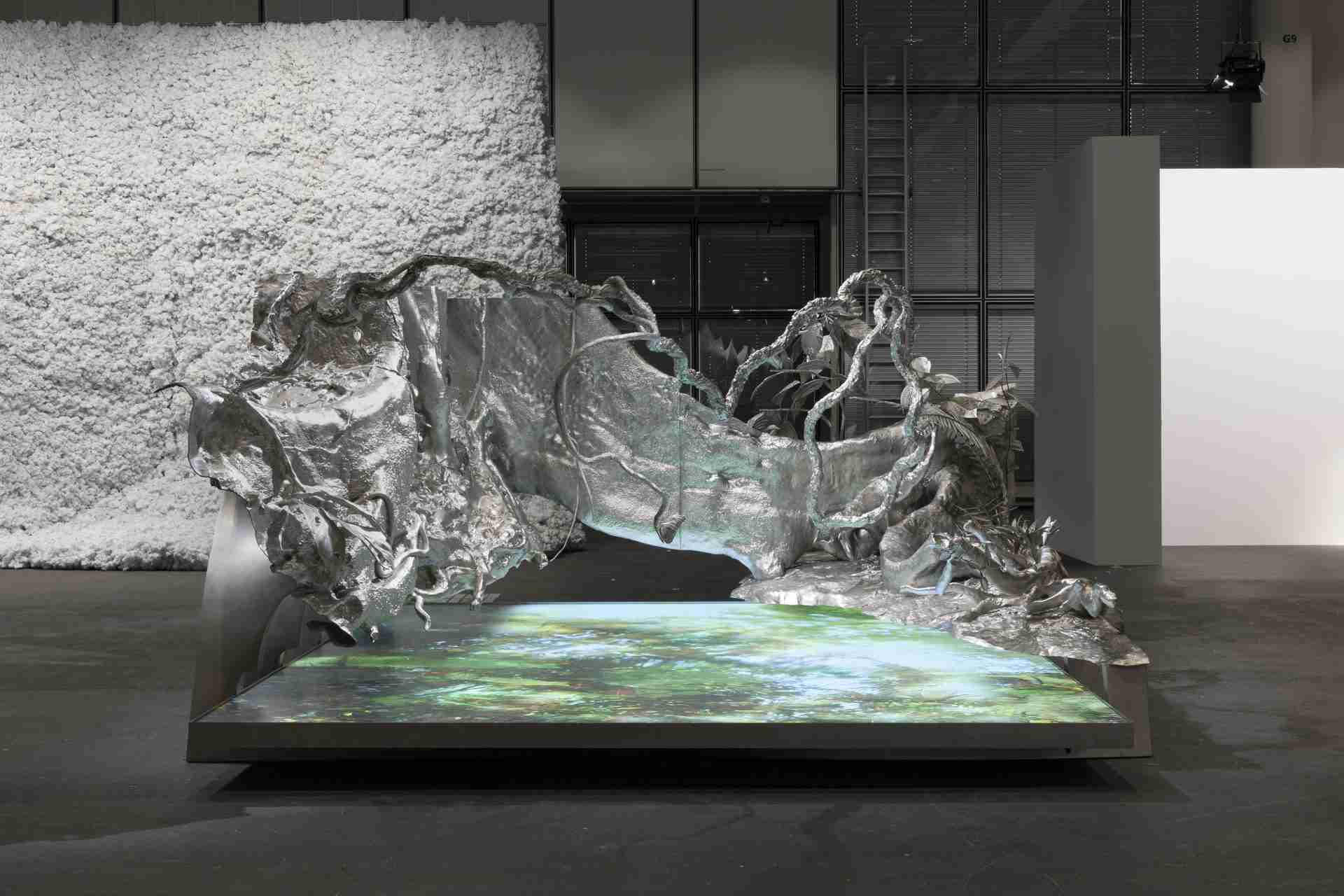
That matters now. Too much ecological art knows exactly how to look wounded. Si-Qin interested me because the wound was not enough. The work tried to reorganize perception, almost like a ritual designed after catastrophe. There was beauty, but it was not decorative consolation. It had a synthetic edge. It knew that the sacred, today, may return through design, code, artificial light, and constructed environments rather than through purity.
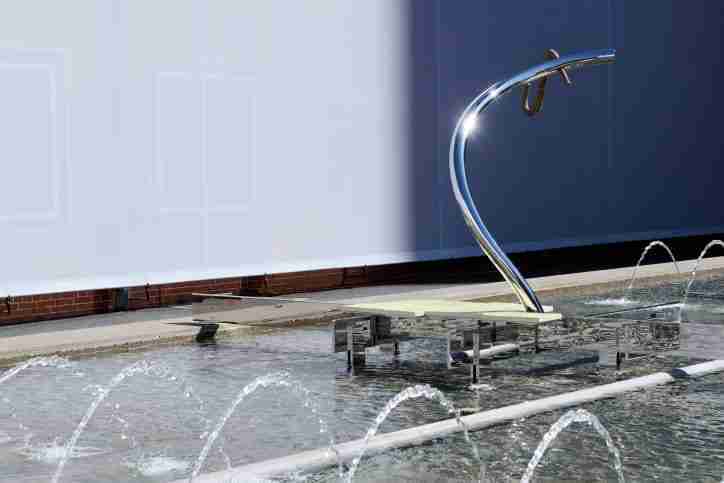
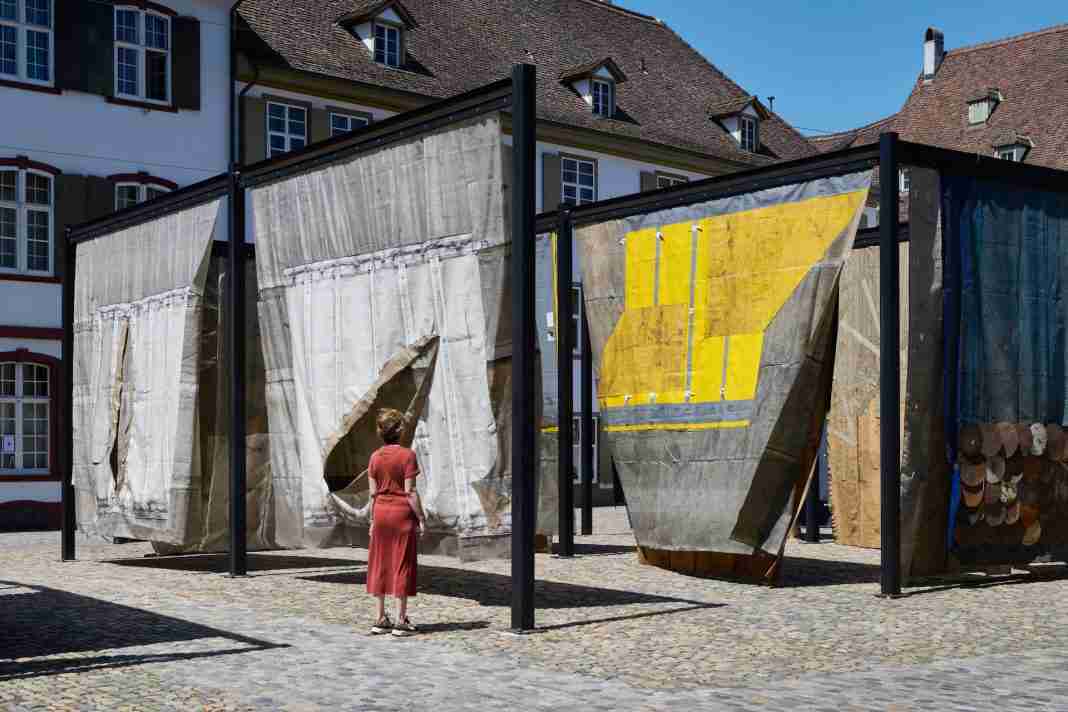
Outside the fair’s interior logic, Nairy Baghramian and Ibrahim Mahama opened another kind of question. Their public commissions mattered because they interrupted the fair’s closed temperature. Baghramian’s work on Messeplatz and Mahama’s on Münsterplatz made Basel feel less like a container and more like a city temporarily forced to negotiate with the fair’s power.
Baghramian has always interested me for the way her sculpture seems to resist completion. Her forms often feel interrupted, anatomical, unstable, as if the object had reached visibility without becoming fully available. Mahama works from another pressure: fabric, labor, architecture, colonial memory, public scale. His materials carry use before they carry meaning. In both cases, what I valued was the break from booth logic. The work did not behave like an object waiting to be placed. It pressed against the conditions of placement itself.
Inside the halls, some of the most interesting moments came from artists whose visibility has a complicated history. Judy Chicago, presented by Jessica Silverman in a booth that also included Rose B. Simpson, Loie Hollowell, Woody De Othello, GaHee Park, and Atsushi Kaga, raised a problem I could not avoid. What happens when an artist whose work once fought for recognition is finally placed inside one of the most powerful machines of recognition in the world?
This is not a cynical question. Chicago’s presence matters. Her history matters. Feminist art needed those battles. But the fair also knows how to absorb what it once did not know how to value. Standing there, I felt both admiration and discomfort. Not because the work had lost force, but because the system around it had become fluent in honoring force after the danger has been managed.
Rose B. Simpson gave me another kind of answer. Her work does not seem to wait for institutional permission to become contemporary. It carries body, ancestry, construction, injury, and dignity without reducing them to a label. I liked that. Some works in fairs behave as if the wall text will rescue them. Simpson’s work does not need rescue. It has a built pressure, something held in the object before language arrives.
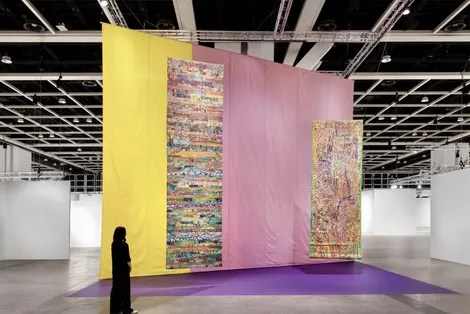
Pacita Abad, shown by Silverlens with Yee I-Lahn and Geraldine Javier, stayed with me because her color did not empty out into pleasure. In a fair, color can become very dangerous. It seduces quickly. It photographs well. It risks being consumed before it has produced thought. Abad’s work resists that flattening. The color is not surface alone. It carries travel, migration, textile, politics, joy, and refusal. It is generous without becoming harmless.
Yee I-Lahn worked more slowly on me. Perhaps too slowly for the fair, and that is precisely why I remember her. Her work asks for crossings: geography, weaving, colonial memory, local structures of knowledge. It does not surrender itself to instant legibility. At Art Basel, that refusal feels almost rude, in the best sense. The fair asks works to become readable quickly. Yee’s work keeps some of its intelligence at a distance.
June Crespo, presented by Ehrhardt Flórez in Premiere, gave me one of the clearest physical experiences of the fair. Her large wall sculpture did not simply occupy the booth. It made the booth feel pressured, almost bodily. I am drawn to works that alter the behavior of a space rather than decorate it. Crespo’s materials seem to have passed through resistance. They do not arrive as elegant solutions. They arrive as forms that have had to push their way into visibility.
Wang Tuo’s Intensity in Ten Cities, shown by White Space, remained for a different reason. Six-channel video installations can easily become exhausting in a fair, where time is already broken. But the fragmentation here felt necessary. Modern Chinese architecture, suppressed personal histories, sexual minority narratives: these subjects could have become a clear lesson. Instead, the work seemed to protect history from becoming too available. I liked that it did not behave like a documentary argument. It left perception unsettled.
Then there was Irma Blank, in P420’s presentation with Laura Grisi, Ana Lupas, Adelaide Cioni, June Crespo, and Francis Offman. Blank’s work unsettles me because it stays close to language while denying language its usual victory. In a fair, everything is named, priced, contextualized, placed, translated into conversation. Blank’s silence felt severe. Not empty. Severe. A refusal to let language possess the work completely.
By late afternoon, I was no longer the same viewer who had entered the fair.
This is what interests me most now. Not the list of trends. Not the market temperature. Not who sold what, or which booth was most elegant. Those things matter, but they have already found their writers. What interested me was the way Art Basel changed my looking. At the beginning, I gave importance where importance had already been prepared. Later, tired, less polite, less willing to be impressed, I began to see differently.
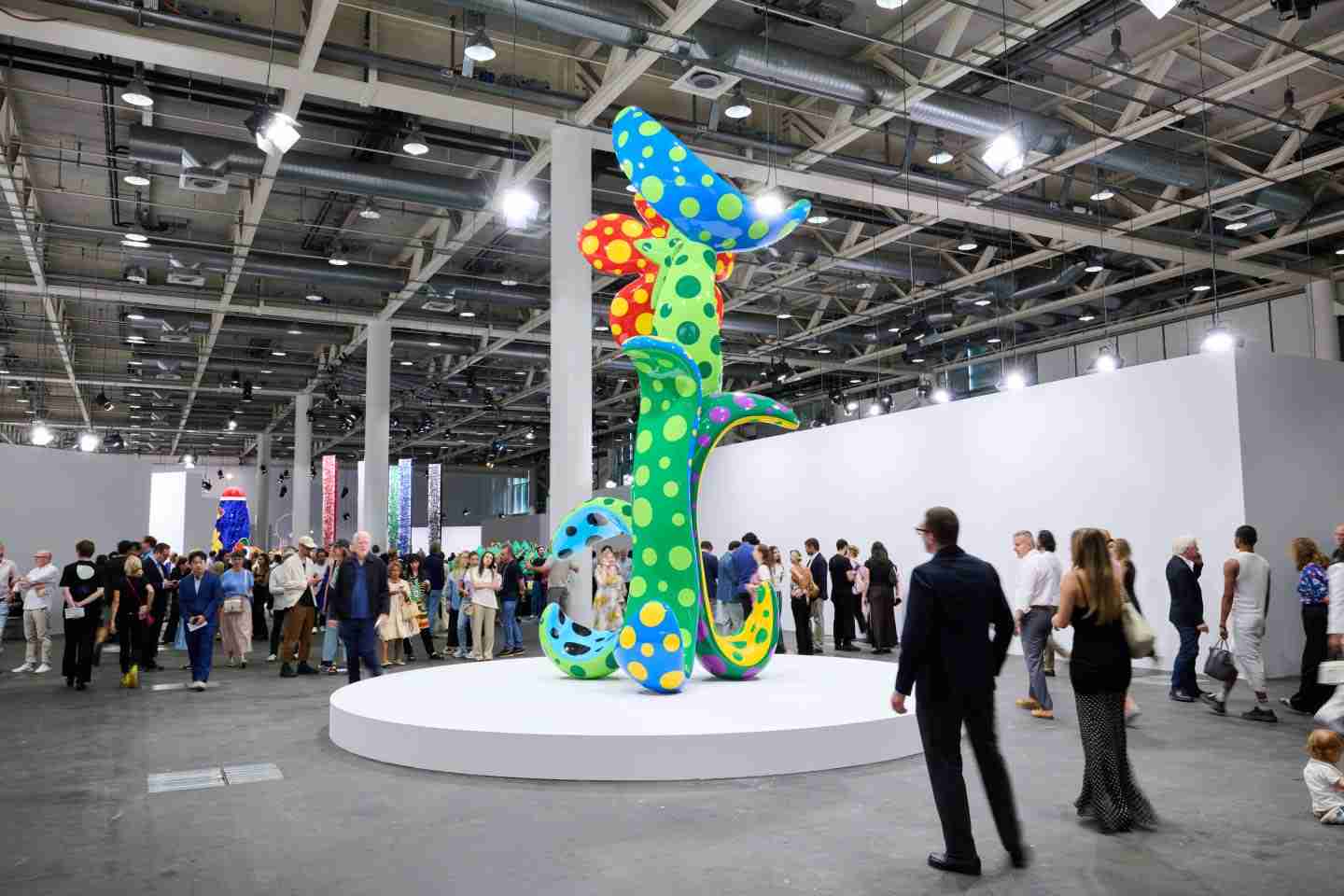
Fatigue became a filter.
When the body is fresh, the eye is social. It follows reputation. It respects scale. It reads the room. It understands where attention is supposed to gather. But when fatigue arrives, some of that training weakens. One stops wanting to perform intelligence. One stops pretending to be endlessly available. Then the work has to do something harder. It has to reach a viewer who no longer wants to be seduced.
That is the second look.
The first look belongs partly to the fair. The second look, when it happens, belongs more to the work.
This is why I left Basel thinking less about visibility than about endurance. Not endurance as monumentality. Not endurance as market value. Endurance as the capacity of a work to continue after the apparatus has moved on. After the booth. After the photograph. After the polite sentence. After the name recognition. After the first impression has spent itself.
Si-Qin, Baghramian, Mahama, Chicago, Simpson, Abad, Yee, Crespo, Wang, Blank: I would not force these artists into a single argument. They do not need that. What connected them, for me, was more fragile and more personal. Each resisted, in a different way, the violence of immediate consumption.
That may be one of the few critical tests still worth keeping at a fair like Art Basel.
Not whether an artwork can be seen. Everything can be seen now.
Not whether it can be photographed, explained, sold, circulated, or admired. The machinery already knows how to do all that.
The question is whether the work returns when the machinery has stopped helping it.
In Basel, many things appeared. Fewer things remained. I am beginning to think that criticism starts there, in that small delay between what dazzles and what comes back.
Related Articles
- Pussy Riot and FEMEN Protest at the Russian Pavilion at the Venice Biennale
- The Pavilion of Nature at the Venice Biennale
- Nick Cave at the 2026 Biennale. Seven works of loss, memory, and protest
- Annalee Davis at Biennale Arte 2026. Landscape as Mourning, Archive, and Resistance
- Kader Attia: Repair Does Not Erase the Wound
- The Polish Pavilion: Language Beyond the Human in Liquid Tongues
- Danish Pavilion Venice Biennale 2026 Who Brought Porn Stars into the Exhibition


