

A Reflection on The Chinese Dog and Beyond
Rethinking Animal Ethics
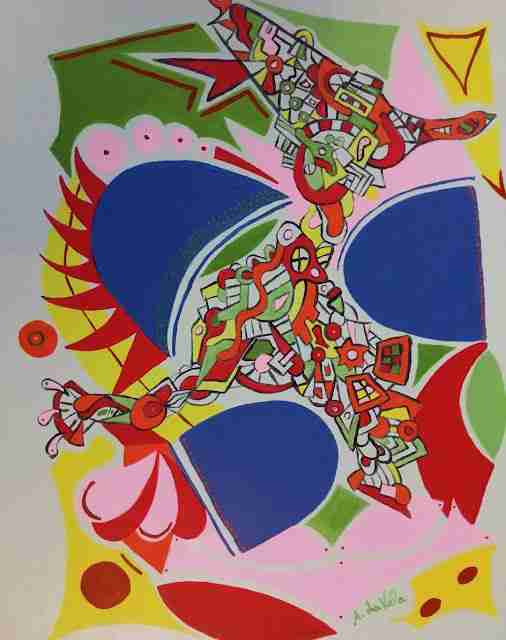
In painting The Chinese Dog, my intention was to create a visual manifesto. It was a bold artistic statement against the suffering inflicted upon animals in events such as the Yulin Dog Meat Festival. I channeled my emotions into a vivid, chaotic composition meant to provoke empathy and reflection. Yet, as I step back and reconsider the broader implications of my critique, I face a troubling paradox. It challenges my own position as an artist and a human who consumes meat.
The Dissonance of Selective Outrage
Why did I feel so compelled to denounce the Yulin Dog Meat Festival? What was it about the suffering of these dogs that stirred such visceral reactions, while I, like billions of others, continue to accept, normalize, and even celebrate the consumption of other animals? In questioning the morality of one cultural practice, I inadvertently upheld another: the Western idea that some animals deserve protection while others do not.
Would it not be hypocritical to critique the consumption of dogs in China while living in a society where beef, pork, and fish form the very foundation of traditional cuisine? If the belief is that eating dogs is inherently cruel, then should the same principle not extend to cows, pigs, chickens, and fish? And if it does not, then the question becomes unavoidable: do some animals inherently deserve more dignity than others, or are these moral hierarchies cultural constructs shaped by geography, tradition, and personal bias?
The Universality of Animal Exploitation
The harsh truth is that every day, across the world, there is a festival of suffering. The Yulin Dog Meat Festival may provoke horror in many, but what of the mass slaughterhouses that operate year-round, hidden from view? What of the cows bred and slaughtered to maintain global demand for beef? What of the billions of chickens crammed into cages, living short and painful lives before their inevitable end? And what of the fish, hauled out of the ocean in quantities so vast that entire ecosystems are stripped bare?
If Yulin is condemned, must the industrial farming of pigs in the United States also be condemned? What about foie gras in France, or ritual slaughter in religious traditions across the world? How is “unacceptable suffering” distinguished from suffering that has simply been normalized as the price of human sustenance?
The Paradox of Octopus Love
Another of my paintings, Octopus Love, was inspired by my admiration for the beauty of Mediterranean octopus mating. I lamented the decline of octopuses due to the warming of the Mediterranean and overfishing. However, did that stop me from eating octopus? Here again, contradictions surface. I marvel at the elegance of nature while also participating in its destruction.

If the beauty of these creatures is truly valued, should dietary habits not shift accordingly? Or is admiration compartmentalized away from consumption, allowing wonder and complicity to coexist without fully colliding?
The Democratic Fallacy: Do Animals Have Rights?
In questioning the ethics of animal consumption, a larger debate opens: can animals possess rights in the same way humans do? Many argue that animals, lacking rational thought and moral reasoning, cannot be granted the same ethical consideration as humans. Yet history shows that similar arguments were used to justify the subjugation of people.
Even in the space of intimacy, contradictions persist. Beloved pets are neutered, removing not only their ability to reproduce but also a fundamental source of pleasure and fulfillment. It is justified as control and responsibility. From another angle, it raises uncomfortable questions about how much of what is done to animals is truly for their welfare, and how much is about shaping them into compliant, convenient companions.
The transatlantic slave trade was built on dehumanizing beliefs that framed Black people as “lesser” and closer to animals, and therefore exploitable without moral consequence. Today, such beliefs are condemned. If intrinsic worth is recognized across humanity, regardless of race or nationality, then the next question becomes sharper: what ethical boundary separates “our” species from the rest, and who benefits from that boundary?
Are Animals Merely Servants to Humanity?
Are all animals, in some way, at the service of humans? If the argument becomes “nature follows the law of the jungle,” then the human no longer appears as Sapiens, a rational being, but as another animal that has manipulated systems to ensure dominance. In the wild, prey have a chance to escape. In the human world, a game has been built where only humans can win.
This extends beyond animals and into human systems of power. If a tiny fraction of humanity controls most of the world’s wealth, the rules are already tilted. If fairness does not reliably exist among humans, how can it be applied to the creatures beneath human power?
The Role of Power and the Influence of Industry
The global meat industry is not merely a reflection of dietary preferences. It is a multi-billion-dollar machine maintained by corporate and political interests. Laws are often designed less to protect animals from suffering, and more to protect industries from disruption. In Italy, a law was recently passed to prevent the development and commercialization of lab-grown meat, an innovation that could reduce, or even eliminate, the need for slaughter.
This is not only about ethics. It is also about control. Governments and corporate entities shape the discourse to ensure humane alternatives remain inaccessible, expensive, or illegal. Consumption choices are presented as personal, while they operate inside systems that are deeply political.
A Call for Consistency, Not Hypocrisy
I do not write this to absolve myself of responsibility, nor to suggest silence in the face of injustice. But if cruelty is opposed, it should be opposed with integrity. Suffering is not defined by species, nor by geography. A dog in Yulin, a cow in Texas, an octopus in the Mediterranean, all experience pain, all deserve consideration.
To those who, like me, have been angered by the Yulin Dog Meat Festival, the challenge is this: outrage should not be directed only at the unfamiliar. The gaze must also turn inward, toward suffering embedded in ordinary habits and local industries. Complicity must be acknowledged. Only then can ethics stop being dictated by convenience and start being shaped by a commitment to justice for all beings, human and non-human alike.
This is not a call to immediate veganism, nor a demand that traditions be erased overnight. It is an invitation to think critically, to question the structures that shape moral views, and to consider whether choices align with the values that are claimed. Change does not begin with condemnation. It begins with reflection, empathy, and the willingness to challenge even deeply held beliefs.


