
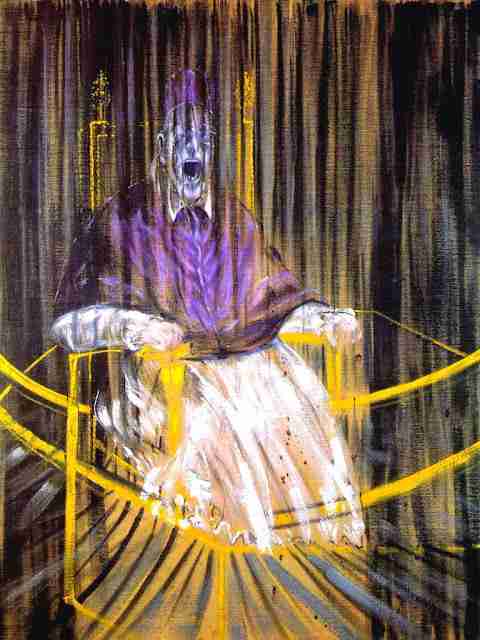
Bacon – Study after Velázquez’s Portrait of Pope Innocent
Unveiling the Inner Turmoil: Francis Bacon’s Interpretation of Velázquez’s “Portrait of Pope Innocent X”
Francis Bacon’s Study after Velázquez’s Portrait of Pope Innocent X is a masterful exploration of psychological depth and artistic reinterpretation.
It is not a replica, but a profound transformation that pulls new meanings out of Diego Velázquez’s original portrait.
Bacon’s vision digs into emotional pressure beneath the surface, offering a modern and intense reimagining of a classical masterpiece.
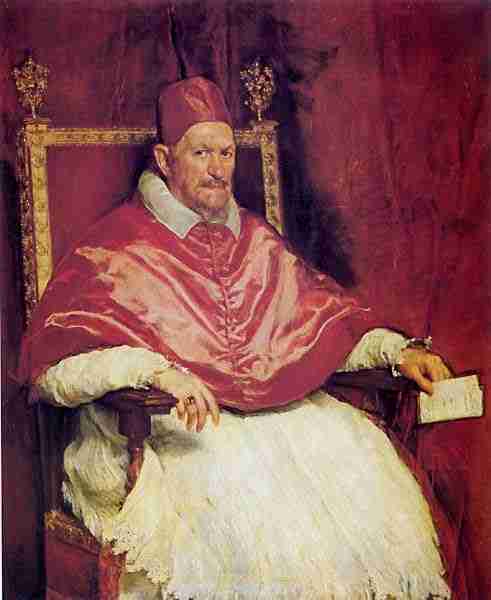
Velázquez’s Original Masterpiece
The original Portrait of Pope Innocent X by Velázquez, created in 1650, is a stunning depiction of composed authority.
The Pope is portrayed in regal attire, exuding solemnity and power. His expression is controlled, dignified, and heavy with responsibility.
Velázquez’s nuanced light and shadow intensify that presence, making the painting a lasting icon of ecclesiastical power.
Bacon’s Radical Transformation
In contrast, Bacon’s 1953 reinterpretation shifts everything in tone and mood.
His painting radiates raw psychological force, as if the figure is breaking under the weight of its own role.
One of the most compelling elements is the “imagined scream”, not literally present in Velázquez, but made palpable through Bacon’s distortions.
The Pope’s face and body become unstable, pushed into a space where authority looks like terror, confinement, or collapse.
Psychological Depth and Emotional Resonance
Alessandro Zinna, in an analysis published on mediationsemiotiques.com, highlights the tension between Velázquez’s restraint and Bacon’s eruption,
suggesting that Bacon exposes what might be latent inside the original image.
In this reading, the scream is not an “addition”, but a revelation: the violence of emotion that power often forces to stay hidden.
Exploring Hidden Narratives
Bacon’s interpretation can be read as a commentary on inner turmoil beneath the facade of stability.
The distorted cage-like space, the vibrating brushwork, and the figure’s disintegration imply that power can be a psychological trap.
The painting asks a brutal question: what happens to the human being who must permanently perform control?
Artistic Dialogue and Historical Impact
Placing Velázquez and Bacon side by side creates a powerful dialogue about representation.
It shows how a masterpiece can act like a charged “container” for later artists, absorbing their century’s anxieties and spitting them back in new form.
Bacon’s study confirms art’s transformative power: reinterpretation can be an act of analysis, not just homage.
Conclusion
Francis Bacon’s reimagining of Velázquez’s iconic portrait is more than a reference to art history.
It is a confrontation with the human psyche, and with the violence that can live inside the public mask of authority.
Bacon honors Velázquez’s genius while using it as a springboard to reveal a darker emotional register, where dignity and horror occupy the same throne.


