
Sandro Chia: Myth, Body and the Theatrical Return to Painting
How Sandro Chia turned myth, color and the human figure into a postmodern stage for painting after Conceptual Art.
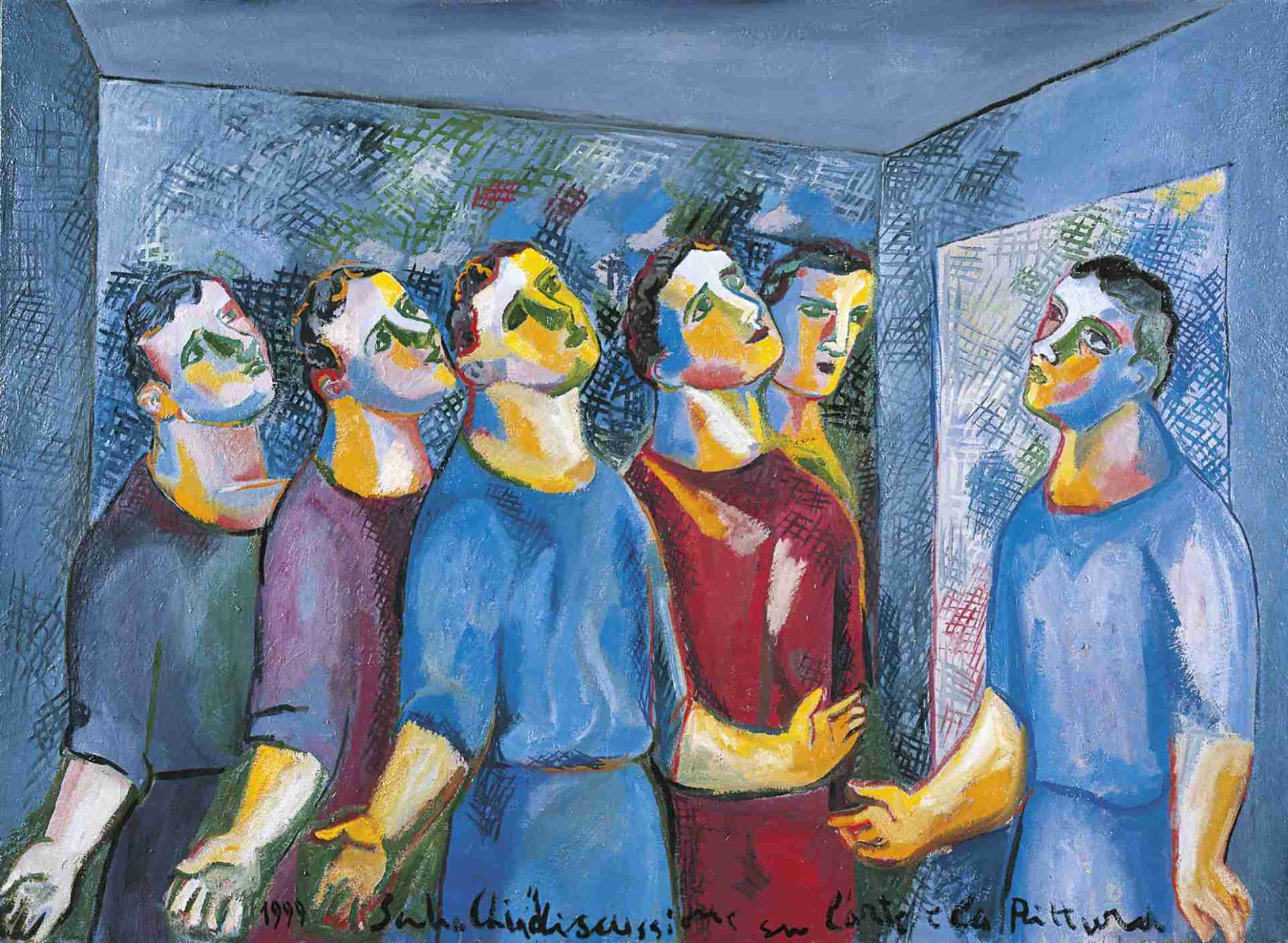
Sandro Chia is often described as one of the leading figures of the Italian Transavanguardia. That is true, but it is also too easy. Chia was not only part of a movement that brought painting back after the dominance of Conceptual Art, Minimalism, and Arte Povera. He helped make that return look theatrical, excessive, physical, and dangerously seductive.
Born in Florence in 1946, Chia belongs to a generation that came after the modernist belief in purity had already begun to collapse. His painting does not try to purify the image. It overloads it. Bodies, myths, gestures, animals, heroes, jokes, colors, and quotations all enter the canvas as if painting had become a stage where Western art history could act out its own contradictions.
That is why Chia matters. He did not simply bring back figuration. He brought back the pleasure and embarrassment of painting at the same time.
Why Sandro Chia Matters in Transavanguardia
Transavanguardia was named by Achille Bonito Oliva in 1979 and brought together artists such as Sandro Chia, Francesco Clemente, Enzo Cucchi, Nicola De Maria, and Mimmo Paladino. Tate identifies these artists as the central figures of the movement.
Yet Chia occupies a specific position within that group. If Francesco Clemente often turns the self into a fragment, and Enzo Cucchi pushes the image toward wound, darkness, and archaic sign, Chia gives Transavanguardia one of its most muscular and theatrical faces.
His paintings are not quiet recoveries of tradition. They are noisy returns. They enter art history with the confidence of someone who knows that the past is not dead, but also knows that it can no longer be used innocently.
From Conceptual Art to the Return of the Image
Before becoming one of the emblematic painters of the 1980s, Chia moved through more conceptual and experimental approaches. National Galleries of Scotland notes that he experimented with Conceptual and Performance Art in the early 1970s before returning to painting in the mid-1970s.
This passage is important. Chia’s painting should not be seen as a naive rejection of Conceptual Art. It comes after that experience. The return to the figure is not a return to innocence. It is a return after the image had already been questioned, dismantled, and accused of being too traditional.
Because of this, Chia’s figures often look strangely aware of themselves. They are heroic, but not simply heroic. Classical, but not simply classical. They seem to know that they are performing a role.
The Human Figure as a Stage
At the center of Chia’s work there is almost always the body. Not the fragile body of confession, and not the neutral body of anatomy. His is a theatrical body: large, muscular, exposed, excessive, and sometimes absurd.
In many works, the figure seems to arrive from classical mythology or Renaissance painting. However, Chia does not restore the classical body as an ideal. He exaggerates it. He twists it into performance. The result is a body that carries memory, desire, parody, and power at once.
This is where Chia becomes more interesting than a simple “return to figuration.” His bodies are not only represented. They act. They pose. They carry the burden of art history while pretending to move freely.
Myth Without Innocence
Chia’s painting often draws on myth, but myth in his work does not function as stable storytelling. It becomes a reservoir of poses, symbols, and emotional intensities. Gods, heroes, athletes, fathers, sons, and solitary figures appear less as characters from a clear narrative than as fragments from a culture that keeps repeating itself.
This is why his painting can feel both ancient and contemporary. Myth is not used to escape the present. It is used to show how the present still needs old forms in order to speak about force, vulnerability, masculinity, ambition, and collapse.
In this sense, Chia’s mythology is never purely decorative. It is a way of asking what remains of the heroic image after modernity has already damaged the idea of heroism.
Color as Energy, Not Decoration
Color is one of the most immediate elements in Chia’s work. His palette can be bright, warm, acidic, dense, and deliberately excessive. But color is not just ornament. It is pressure.
In Chia, color pushes the figure forward. It makes the image louder. It transforms the canvas into a charged surface where the body does not simply appear, but insists on being seen.
This is one of the reasons his work still resists neutral viewing. The paintings do not politely offer themselves to interpretation. They occupy space with a visual confidence that can be seductive and irritating at the same time.
Speed Boy and the 1980s Image
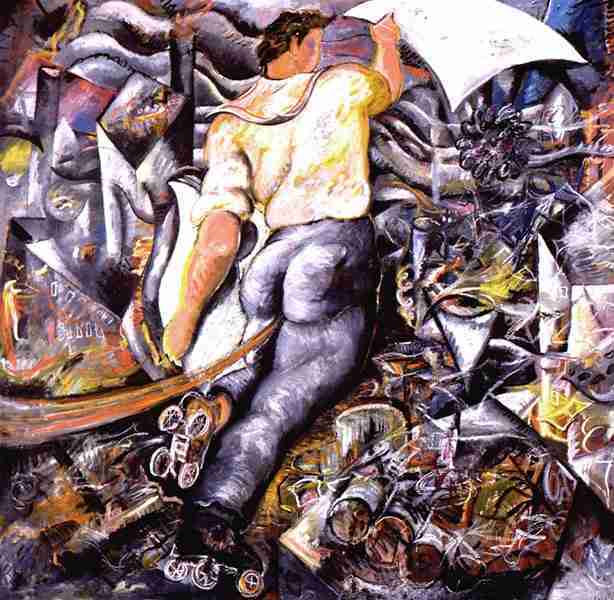
Speed Boy, from 1981, belongs to the moment when Chia’s painting became fully aligned with the energy of the early 1980s. The title itself suggests movement, youth, acceleration, and a kind of restless vitality.
Yet speed in Chia is not only physical. It is cultural. The image moves quickly across references: classical pose, modern distortion, painterly pleasure, and postmodern quotation. The figure becomes a sign of painting’s return, but also of painting’s new condition inside a faster art system.
That is one of the central tensions in his work. Painting comes back as a living language, but it also comes back inside the market, the museum, the magazine, and the international circulation of the 1980s.
Enea and Anchise: The Father, the Son and the Weight of History
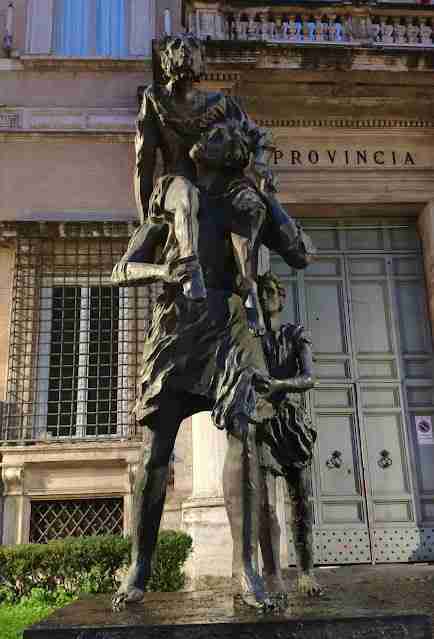
Enea and Anchise makes visible one of Chia’s strongest concerns: the relationship between the body and inherited history. The myth of Aeneas carrying his father Anchises out of Troy is already a story about survival, burden, origin, and transmission.
In Chia’s hands, this subject becomes more than an ancient episode. It becomes a painting about what it means to carry the past without being crushed by it. That may also be a useful metaphor for Transavanguardia itself.
The movement carried art history back into contemporary painting, but not as obedience. It carried it as weight, material, theatrical costume, and sometimes as provocation.
Chia, Florence and the Problem of Tradition
It is impossible to ignore Florence when looking at Chia. The city is not simply a biographical detail. It is a symbolic pressure. To come from Florence means to come from one of the most overdetermined places in Western art history.
For some artists, that weight could become paralyzing. For Chia, it became usable. Renaissance memory, classical form, and the heroic figure are not accepted as fixed models. They are reactivated, inflated, distorted, and made almost unstable.
This is the difference between tradition and quotation. Tradition asks for continuity. Chia often gives us interruption, exaggeration, and theatrical reuse.
The International Chia
Chia’s work entered major international collections and exhibitions. MoMA lists several works by the artist in its collection, including works from the early 1980s. Kettle’s Yard also identifies him as an artist who contributed to the development of Transavanguardia after an initial conceptual phase.
This international presence is not secondary. Transavanguardia became powerful because it offered the global art world a new image of Italian painting at the exact moment when expressive figuration was gaining renewed visibility.
Chia’s work fitted that moment perfectly, but not passively. It gave the 1980s a painting that was immediately legible, visually strong, and historically loaded.
The Risk of Too Much Painting
There is also a risk in Chia’s work, and it should not be avoided. His painting can sometimes seem almost too confident in its own painterly power. Too heroic, too theatrical, too full of itself.
But that excess is part of the point. Chia’s work stages the return of painting as both liberation and problem. It asks whether painting can come back without becoming spectacle, whether myth can return without becoming nostalgia, and whether the figure can still carry meaning after so many historical collapses.
For me, this is where Chia remains alive. Not because every painting resolves the contradiction, but because the contradiction is visible.
Why Sandro Chia Still Matters Today
Today, when painting has once again become central in the art market and in contemporary exhibitions, Chia’s work feels unexpectedly relevant. Many younger artists now move through figuration, quotation, fantasy, mythology, and art history with a freedom that Transavanguardia helped legitimize.
At the same time, Chia’s work warns us about the danger of image-power. Painting can be a space of freedom, but it can also become a machine of seduction. It can resist theory, but it can also become branding. It can recover the body, but it can also turn the body into a theatrical sign.
This is why Sandro Chia should not be reduced to a colorful painter of myths and figures. He is one of the artists who made the return to painting both possible and problematic.
A Painter of Return, Excess and Contradiction
Sandro Chia’s importance lies in the way he made painting return with all its unresolved baggage: beauty, history, masculinity, myth, parody, desire, and market visibility. His figures do not simply inhabit the canvas. They carry the burden of painting itself.
That is what makes his work more complex than a celebratory narrative about color and vitality. Chia understood that painting could still be alive, but only if it accepted its own theatricality.
In his best works, painting does not come back as a safe tradition. It comes back as a body on stage, fully exposed, almost excessive, and still impossible to ignore.


