
ZERO Movement: Light, Space, and the “Reset” That Rewired 1960s European Art
ZERO Movement: Light, Space, and the “Reset” That Rewired 1960s European Art
In the late 1950s and 1960s, a group of artists across Europe tried something radical: they attempted to restart art from zero. Not “minimal” as a look, but minimal as a position: less ego, less gesture, less confession, more light, time, vibration, and presence.
This essay sits inside my broader map of the decade. If you want the full context (Pop, protest, media, perception), start here: 1960s Contemporary Art Index.
ZERO began in Düsseldorf with Heinz Mack and Otto Piene (1957), later joined by Günther Uecker. But the real story is bigger than one city: it became a network, a shared desire to rebuild the conditions of seeing after the collapse of certainty that followed World War II.
If you already love movement, light, and systems more than “expression,” you may also want to connect this reading toKinetic Art and Op Art.
Mini-index
- Exhibitions, events, and why the public mattered
- What ZERO changed (and why it still feels contemporary)
- How to look at ZERO without reducing it to “minimalism”
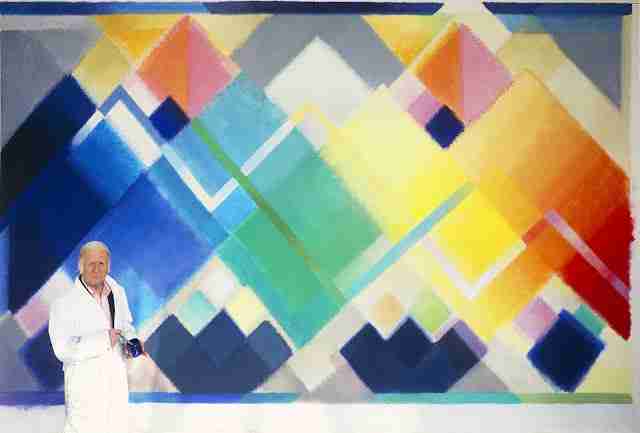
Heinz Mack (ZERO movement). Image from my archive.
Where ZERO begins and what “zero” really means
ZERO was founded in 1957 by Heinz Mack and Otto Piene in Düsseldorf, later joined by Günther Uecker. The name was not a branding trick. It was a position: a refusal of the heroic, suffering-artist mythology that dominated much postwar painting.
After the war, “expression” could feel suspicious: too theatrical, too individual, too easy to turn into a commodity. ZERO proposed a different ethic: start again from a neutral point, and rebuild art from elements that do not belong to a single personality, such as light, air, movement, seriality, and time.
The ZERO visual language: light, repetition, vibration
ZERO is often described as minimalist, but that label can flatten what is specific. Their core move was not reduction for elegance. It was reduction to change the viewer’s physical relationship to the work.
- Light as material: reflection, glare, shimmer, and optical instability are treated as real sculptural facts.
- Repetition as structure: grids, nails, slashes, and serial elements produce rhythm rather than “composition.”
- Industrial surfaces: aluminum, steel, glass, and engineered textures refuse the handmade “signature.”
- Time: the work is not complete in one glance. It activates as you move.
This is where ZERO begins to touch the same nervous system as Op Art: perception is not passive, it is constructed in real time.
A European network, not a local style
ZERO spread because it answered a shared postwar condition: how to rebuild meaning when traditional images feel compromised. That is why it quickly connected with artists across Europe who were also experimenting with monochrome, immateriality, and the limits of the picture plane.
In Italy, the question of “beyond the canvas” resonates strongly with Lucio Fontana, whose spatial cuts are not decoration but a violent opening of the surface into real space.
In France, the overlap with conceptual monochrome and the politics of immateriality intersects with the larger atmosphere that also produced Nouveau Réalisme, even when the aims diverge.
Exhibitions, events, and why the public mattered
ZERO did not only live in studios. It operated through exhibitions, publications, and staged events that treated the public as part of the work’s activation. Light and movement demand an encounter, not a reproduction.
That outward-facing attitude is one reason ZERO continues to feel current: it behaves like an art of environments, prototypes, and systems, not like an art of isolated masterpieces.
What ZERO changed (and why it still feels contemporary)
ZERO helped normalize a major shift in postwar art: the idea that an artwork can be a condition rather than an image. It paved the way for later developments in Minimalism, Conceptual art, kinetic practices, installation, and light-based environments.
If you want to follow that line forward, connect this reading to Kinetic Art, where movement becomes both form and meaning.
How to look at ZERO without reducing it to “minimalism”
- Look for activation: what changes when you move?
- Look for ethics: what does the work refuse (ego, confession, spectacle)?
- Look for engineering: surfaces are built to produce perceptual events.
- Look for the reset: ZERO is a cultural strategy as much as a style.
Takeaway
ZERO is not only a chapter of 1960s European art. It is a method: reduce the noise, rebuild the conditions of seeing, and let light and time do the work that gesture used to do. It stays relevant because it describes a world that is still ours: technological surfaces, mediated attention, and the need to design new forms of presence.


