
Journey Through Psychedelic Art: Exploring the Colors of Consciousness
Psychedelic Art: Visualizing Altered States and Countercultural Imagination
Psychedelic art is a genre that pushes past conventional realism and treats perception itself as a subject. It draws from the visual logic of altered
states—shifting scale, intensified color, looping patterns, and images that feel both hyper-detailed and unstable. Whether the reference point is LSD,
mescaline, or psilocybin, the core idea is the same: inner experience becomes a legitimate landscape to map, translate, and share.
The 1960s: Posters, Music, and a New Visual Grammar
The genre reached its most iconic public form during the 1960s counterculture, when new attitudes toward consciousness, politics, and community were
matched by equally radical design. In San Francisco, artists such as Rick Griffin, Victor Moscoso, Wes Wilson, and Stanley Mouse & Alton Kelley
developed a poster language for concerts and venues that looked like the visual equivalent of feedback: dense, vibrating, and impossible to ignore.
These images did more than advertise a show. They became symbols of an era that treated art as a tool for liberation, belonging, and refusal.
Key Visual Traits
Psychedelic art is recognizable because it behaves differently from “normal” images. It prioritizes sensation over stable perspective and builds
compositions that feel alive—swelling, repeating, and morphing in front of your eyes.
- High-contrast color that amplifies intensity and emotional charge.
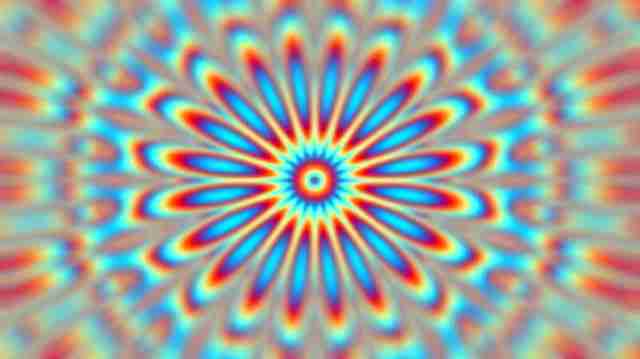
- Kaleidoscopic repetition, mirrored structures, and fractal-like patterning.
- Surreal or metaphysical imagery where figures, symbols, and environments fuse.
- Optical movement through spirals, concentric waves, diffraction effects, and pulsing rhythms.
- Radical typography where letters melt, twist, and become image rather than message.

Beyond San Francisco: Global Influence
Although the Bay Area is often treated as the genre’s epicenter, psychedelic aesthetics spread rapidly across music, fashion, publishing, and fine art.
Optical experimentation and perceptual instability connected it to Op Art and to broader modernist research into vision. In popular culture, it became
the look of a generation: a visual signature for sound, rebellion, and new forms of spirituality.
Album-cover design made this influence unavoidable. Psychedelic imagery offered musicians a second stage: a visual performance that framed the music
as an experience rather than a product. The result was a culture where image, sound, and identity merged into a single, immersive language.
Why It Still Matters
Psychedelic art endures because it speaks to a permanent human impulse: the desire to represent states that words cannot hold. It invites the viewer to
slow down, to get lost, to accept ambiguity, and to feel the image instead of simply reading it. In an age of distraction and compressed attention,
its density becomes a form of resistance—an insistence that perception can still be expanded.


